
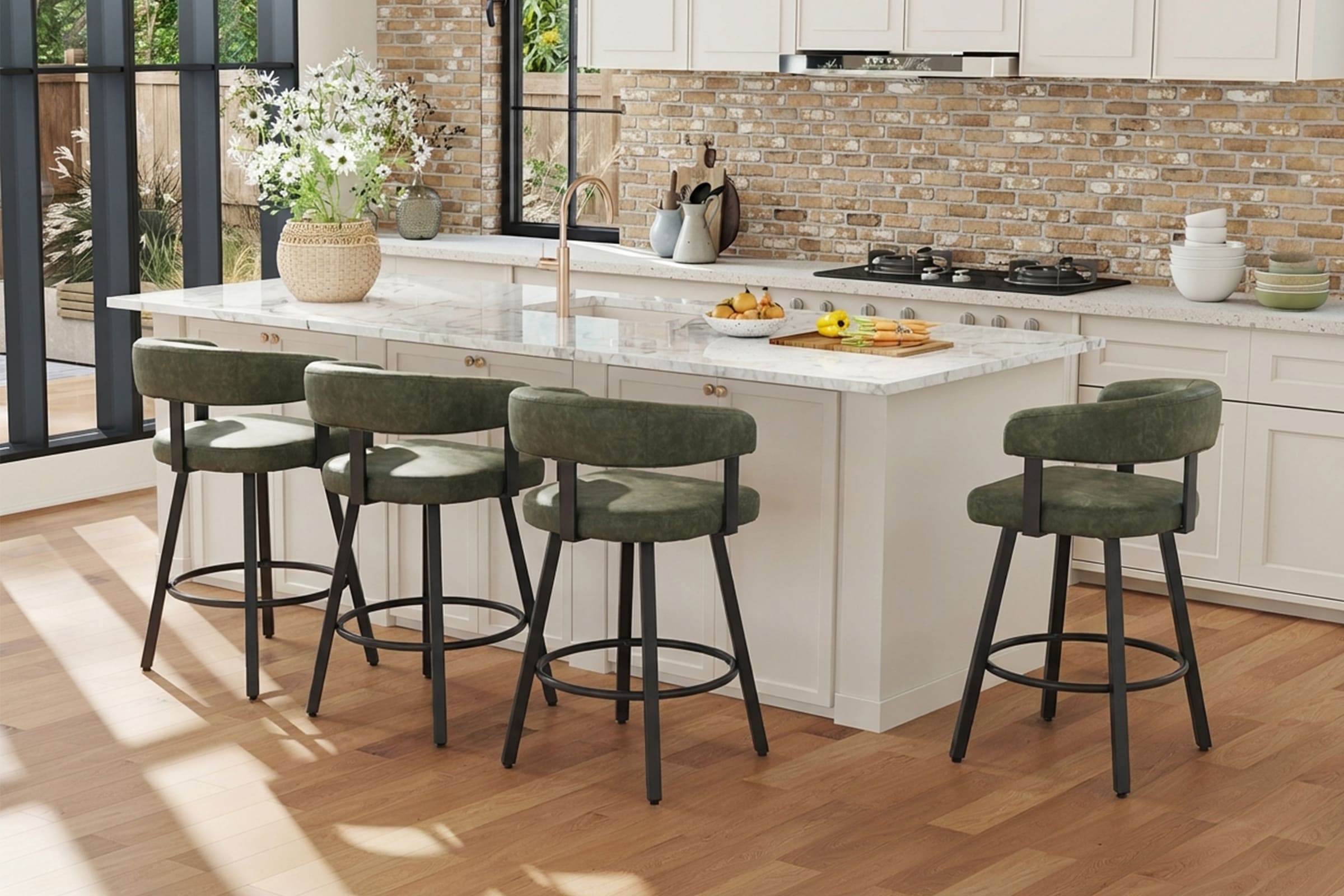
Introduction
Picking bar stool height sounds simple until you are staring at a 36-inch counter, two product pages, and a seat that looks right but feels wrong. A stool that sits too high crowds your knees, pushes your shoulders up, and makes quick breakfasts feel awkward. A stool that sits too low creates the opposite problem: slouching, poor elbow position, and a kitchen island that never feels easy to use.
This guide sorts out bar stool height for a standard home kitchen in a practical order. First, you will see how to measure the real seating zone, not just the countertop edge. Next, you will match seat height to surface height, check knee room, and plan spacing for kitchen island stools. Then we will look at comfort features that matter for daily use so you can choose with confidence instead of guessing.
Bar Stool Height Fundamentals for a Standard Home Kitchen
A good stool fit starts with one principle: measure the surface first, then choose the seat. In most homes, a standard kitchen counter is about 36 inches high, while a true bar-height surface is usually about 40 to 42 inches high. That difference sounds small, but it is large enough to change what seat height feels comfortable day after day. The common target is about 10 to 12 inches between the seat and the underside of the counter or overhang, which usually keeps knees, thighs, and elbows in a workable position. The reference guides from Kouboo, Urban Forge, and EMFURN all follow this same logic, even if their exact ranges vary slightly. (urbanforge.com)
What counts as a standard kitchen counter
For most residential kitchens, the working assumption is a 36-inch counter. That is why counter stool height usually lands in the 24 to 27 inch range, while bar stool height for taller surfaces moves into the 28 to 33 inch range. If you use the words interchangeably while shopping, you can easily buy stools that look close in photos but feel obviously wrong when they arrive. (urbanforge.com)
Why the underside matters more than the top
The visible countertop height is only part of the story. Your knees do not sit under the polished top edge; they sit under the apron, support rail, or thick slab overhang. That means the best measuring point is the underside where your legs actually need clearance. Even a thick top or deep apron can remove an inch or two of usable room, which is enough to turn an acceptable counter stool height into a cramped setup.
The comfort target most people should use
If you want a dependable rule, keep these numbers in mind:
- Standard kitchen counter: about 36 inches high
- Best seat height for that counter: about 24 to 27 inches
- Typical bar-height surface: about 40 to 42 inches high
- Best seat height for that surface: about 28 to 33 inches
- Ideal seat-to-underside gap: about 10 to 12 inches
What this means is simple: you are not buying by label alone. You are buying for the actual clearance in your kitchen.
Why fit matters beyond comfort
A bad stool height does more than feel annoying. It can change posture, balance, and how safely people get on and off the seat, especially in busy kitchens where people twist, reach, and step around each other. The CDC notes that about 37% of older adults who fall report an injury that requires medical treatment or restricts activity for at least one day. That statistic is not about bar stools specifically, but it is a useful reminder that stable seating, good foot support, and easy entry matter in real homes. (cdc.gov)
Measure the Surface First
Most bar stool height mistakes happen before shopping even starts. People measure to the top of the counter, round up, and assume the label "counter height" will do the rest. In practice, the better method is to measure the exact spot where someone will sit. That gives you the true target for counter stool height and helps you avoid buying kitchen island stools that only fit on paper.
What to measure
Use a tape measure and check these points:
- Floor to countertop top
- Floor to countertop underside
- Depth of overhang
- Any apron, trim, or support rail
- Width of the seating side of the island
If the kitchen floor is uneven, measure in two places. If the island has decorative trim, measure from the lowest point that could affect knee space.
Common mistake
The most common mistake is using the finished top height only. A 36-inch standard kitchen counter may still feel tight if the underside is lower than expected. Thick stone tops, waterfall edges, and built-in support frames can all reduce real legroom.
What this means in a real kitchen
If your countertop measures 36 inches to the top but only 35.5 inches to the underside, a 26-inch stool may feel better than a 27-inch stool. That single inch can be the difference between relaxed knees and constant contact with the underside. Urban Forge also emphasizes measuring accurately first, because the seat range only makes sense once the surface height is confirmed. (urbanforge.com)
Match Seat Height to Counter Height
Once the surface is measured, the next step is direct matching. This is where most shoppers want a simple answer, and for many homes the answer is straightforward: a standard kitchen counter usually wants a 24 to 27 inch seat. The reason is posture. With the right bar stool height, your forearms can rest naturally near the counter, your knees are not trapped, and your feet can use the footrest instead of dangling.
Best fit by surface height
| Surface height | Best seat height | Typical use |
|---|---|---|
| 35–37 in. | 24–27 in. | Standard kitchen counter |
| 40–42 in. | 28–33 in. | Home bar or raised bar |
| 46+ in. | 33–40 in. | Extra-tall bar setup |
Why ranges matter
A range works better than one fixed number because seat shape, cushion compression, and apron depth all affect feel. A heavily padded stool can sit a little higher once you are on it. A thinner, firmer seat may feel closer to its listed measurement. That is why the best counter stool height is usually a starting range, not a single universal answer.
Chairus product fit

The Chairus 25.5"H Leather Open Back Counter Stools Set of 2 - 2008CS is a strong example of a standard kitchen counter match. It uses a 25.5-inch seat height, which lands in the safe zone for most 36-inch counters. The open-back form keeps the profile light, while the padded seat, lumbar-supporting curved back, metal frame, and built-in footrest make it more practical for longer kitchen use than a purely decorative stool. Chairus lists overall dimensions of 20" D x 21.75" W x 34.75" H and a 330 lb weight capacity, which helps when you are checking both fit and durability for daily island seating. ([chairus.com])
- Best fit: 36-inch counters and islands
- Good for: daily meals, coffee breaks, casual work
- Key specs or signals: open back, padded seat, footrest, metal frame
- Watch-out: verify apron depth before choosing the taller end of any range
Shop: 25.5"H Leather Open Back Counter Stools Set of 2 - 2008CS
Plan Knee Room and Leg Comfort
A stool can have the correct label and still feel wrong if the clearance is off. That is why knee room deserves its own check. The general target is 10 to 12 inches between the seat and the underside of the counter, but you also need enough depth for your legs to move under the overhang. If the island is shallow or framed with a thick apron, people end up sitting too far back or too far forward, which creates slouching and pressure under the thighs.
What to check
Before you buy, confirm these three fit points:
- Seat-to-underside gap: 10-12 inches
- Overhang depth: enough for knees and shins
- Footrest position: easy to reach without pointing toes hard downward
Why it matters
When knee room is tight, people do not sit upright for long. They perch on the front edge, lean away from the counter, or rotate sideways. That can make even short kitchen tasks feel uncomfortable. Good leg comfort is not only about softness. It is about geometry.
Chairus product fit
The Chairus Modern Bar Stools with Back Set of 2 - 5117BS is useful here because it shows how feature sets affect comfort, not just raw height. Chairus lists two relevant versions on the same product page: a 30-inch non-swivel version with overall dimensions of 22" W x 22.25" D x 41" H, and an adjustable swivel version with overall dimensions of 22" W x 23.5" D x 36.25-45" H and a seat height range of 25.5-34.25 inches. The adjustable model is especially helpful when your island falls between categories or when several people use the same seating zone. It also adds arms, a padded back, and a circular footrest, which can reduce leg fatigue during longer sitting sessions. Capacity is listed at 300 lbs. ([chairus.com])
- Best fit: counters or bars with uncertain clearance
- Why it matters: adjustable seat height helps fine-tune knee room
- Key specs or signals: 25.5-34.25 in. adjustable seat, swivel option, padded back, arms, metal base
- Common mistake: assuming an adjustable stool solves a shallow overhang problem by itself
Shop: Modern Bar Stools with Back Set of 2 - 5117BS
Space Multiple Stools Correctly
Height is only half the decision. The other half is spacing. A row of stools that technically fits across the island can still feel crowded when people sit down, swivel, or try to stand up. The usual planning range is about 24 to 30 inches of width per stool, with more room needed for arms, thicker cushions, or swivel movement. That is why kitchen island stools should be planned as a group, not chosen one at a time.
A practical spacing framework
Use this quick rule set:
- 24 inches per stool: compact seating, armless or slim stools
- 26-28 inches per stool: comfortable everyday spacing
- 28-30 inches per stool: armchairs, swivel stools, larger users
What to check
Look beyond seat width alone. Check:
- Overall stool width
- Arm flare or back width
- Swivel sweep zone
- Distance from walls or appliance handles
- Walk path behind the seating area
Common mistake
Many people measure the island length and divide by the number of stools. That misses the fact that bodies need side clearance, not just seat pan width. A 21.75-inch wide stool can still need 26 inches or more of planning space once movement is included.
Best fit
If your island is narrow or the walkway behind it is tight, prioritize slimmer profiles and easier tuck-in shapes. If your island is long and used for family meals, give each person extra side room. That makes the space feel calmer and keeps entry and exit from turning into a daily shuffle.
Choose Features for Daily Use
Once the numbers are right, features decide whether a stool works for ten minutes or two hours. This is where style should follow use. A stool for quick morning coffee can be simpler than one used for homework, laptop work, or long conversations while cooking. The best bar stool height still needs the right support features around it.
Features that improve comfort
- Backrest: better for meals, longer sitting, and posture support
- Footrest: reduces pressure under the thighs and helps balance
- Swivel: easier entry and exit in tighter layouts
- Open back: visually lighter and easier to move around
- Arms: more support, but needs more width and clearance
What this means for stool selection
If the stool will be used daily, comfort features matter more than trend details. A footrest is especially important because even the right counter stool height feels awkward when feet hang without support. An open-back model often balances comfort and visual lightness better than a fully enclosed design.
How to Choose the Right Bar Stool Height
The easiest way to choose is to decide in this order: surface height, actual underside clearance, seating duration, and layout width. If you skip that sequence, you will probably overfocus on looks and undercheck fit. For most homes, the right answer is not complicated once the measurements are real.
Quick decision table
| Situation | Seat height | Priority | Best profile |
|---|---|---|---|
| Standard kitchen counter | 24–27 in. | Knee clearance | Counter stool |
| Raised home bar | 28–33 in. | Elbow height | Bar stool |
| Tight island depth | Lower end of range | Legroom | Slim or backless |
| Long sitting sessions | Exact fit first | Support | Back and footrest |
| Mixed users or in-between height | Adjustable | Flexibility | Swivel adjustable |
What to check before you buy
- Measure to the underside, not just the top
- Keep 10-12 inches between seat and underside
- Match stool width to island length
- Add room for arms or swivel movement
- Choose comfort features based on actual use time
Best fit by common kitchen scenario
If your home has a 36-inch standard kitchen counter, start with a 24 to 26 inch seat and only move higher if the underside clearance supports it. If your kitchen island stools need to double as work seating, prioritize a backrest and footrest. If your island is narrow, a lighter open-back or backless shape usually performs better than a bulky lounge-style frame.
Best Practices & Pitfalls
Good stool buying is mostly about avoiding predictable mistakes. The best setups feel natural because the measurements, spacing, and support features all work together. When one part is off, the problem shows up every day.
Best Practices
- Measure the real seating zone. Always measure floor to underside first, then confirm the finished top.
- Stay within the right seat range. For a standard kitchen counter, 24 to 27 inches is usually the safest zone.
- Plan by the whole stool. Width, arms, and swivel matter as much as seat height.
- Think about time in seat. Quick snacks need less support than long dinners or homework sessions.
- Use foot support as a comfort test. A footrest often separates a decorative stool from one people actually enjoy using.
Common Pitfalls to Avoid
- Confusing counter height with bar height. This is the most common buying error.
- Ignoring apron depth. Decorative trim can steal needed knee room.
- Overcrowding the island. Too many stools make the whole kitchen harder to use.
- Buying for photos only. Upholstery and silhouette matter, but fit has to come first.
- Assuming adjustable solves everything. It helps with seat height, but not with shallow overhang or narrow spacing.
Conclusion
The right bar stool height for a standard home kitchen usually comes down to one reliable match: a 24 to 27 inch seat for a 36-inch counter, with about 10 to 12 inches of clearance to the underside. That is the baseline that keeps posture, knee room, and everyday comfort working together.
If you remember only one process, make it this: measure first, confirm clearance second, and choose features last. Once those pieces are in order, selecting kitchen island stools becomes much easier, and your finished space will feel comfortable instead of merely coordinated.
FAQ
can you recommend the right bar stool height for a typical home kitchen setup?
For most standard home kitchens, a seat height of 24 to 27 inches is the right starting point. That range usually fits a 36-inch counter, which is the most common standard kitchen counter height. The goal is to leave about 10 to 12 inches between the seat and the underside of the counter so your knees have room to move. If your countertop has a thick apron or support rail, stay near the lower end of the range. If the underside is open and generous, a slightly taller counter stool height may still feel comfortable.
what stool height works best for a 36-inch kitchen island?
A 24 to 26 inch stool is usually the safest choice for a 36-inch kitchen island. Many buyers jump straight to 27 inches, but that only works well when the underside clearance supports it. You should measure from the floor to the underside where your knees will sit, not only to the countertop top. If that measurement is tight, a lower seat will often feel better even though the counter itself is standard. This is why two kitchens with the same counter height can need slightly different stool fits.
are counter-height stools the same as bar-height stools?
No, counter-height stools and bar-height stools are different categories. Counter stools are generally made for surfaces around 35 to 37 inches high, while bar stools fit surfaces around 40 to 42 inches high. In practical terms, counter stool height is usually 24 to 27 inches, while bar stool height usually lands around 28 to 33 inches. That difference is large enough to affect posture, foot placement, and knee clearance immediately. If you mix up the two labels, the stool will almost always feel obviously off once you use it.
how do i measure my counter to pick the right stool height?
Measure from the floor to the underside of the countertop or apron where your knees will actually go. That number matters more than the finished top edge because it determines the real legroom. After that, choose a stool that leaves about 10 to 12 inches between the seat and that underside. You should also check the overhang depth, because shallow overhangs limit how far your knees can tuck under the island. If the floor is uneven, take measurements in more than one spot before ordering.
what seat height should i get for a standard kitchen counter?
For a standard kitchen counter, most people should look for a seat height between 24 and 27 inches. The best exact number depends on the thickness of the countertop, any apron or trim, and how firm or padded the seat is. A 25 to 26 inch seat is often the safest middle ground for everyday use. If the stool has a thicker cushion, it may feel slightly taller in practice. That is why the most comfortable fit comes from matching the seat to the real clearance, not just the product label.
should i buy adjustable-height stools if my counter height is in-between?
Yes, adjustable-height stools can be a smart option when your surface sits between standard counter and bar ranges. They are also useful when different people in the home prefer different seating positions. An adjustable model helps you fine-tune bar stool height without committing to a single fixed number right away. However, adjustment does not solve every fit issue. You still need enough knee room, enough overhang depth, and enough width for the stool to work well in your kitchen.
how much space should i leave between kitchen island stools?
A practical planning range is 24 to 30 inches of width per stool. Slim, armless stools can work near the lower end, while wider or swivel designs usually need more room. If the stools have arms, curved backs, or thick upholstery, give each seat extra space so people can get in and out easily. You should also think about the walkway behind the stools, especially near appliances or traffic paths. Good spacing makes the whole kitchen feel easier to use, not just the seating area itself.