
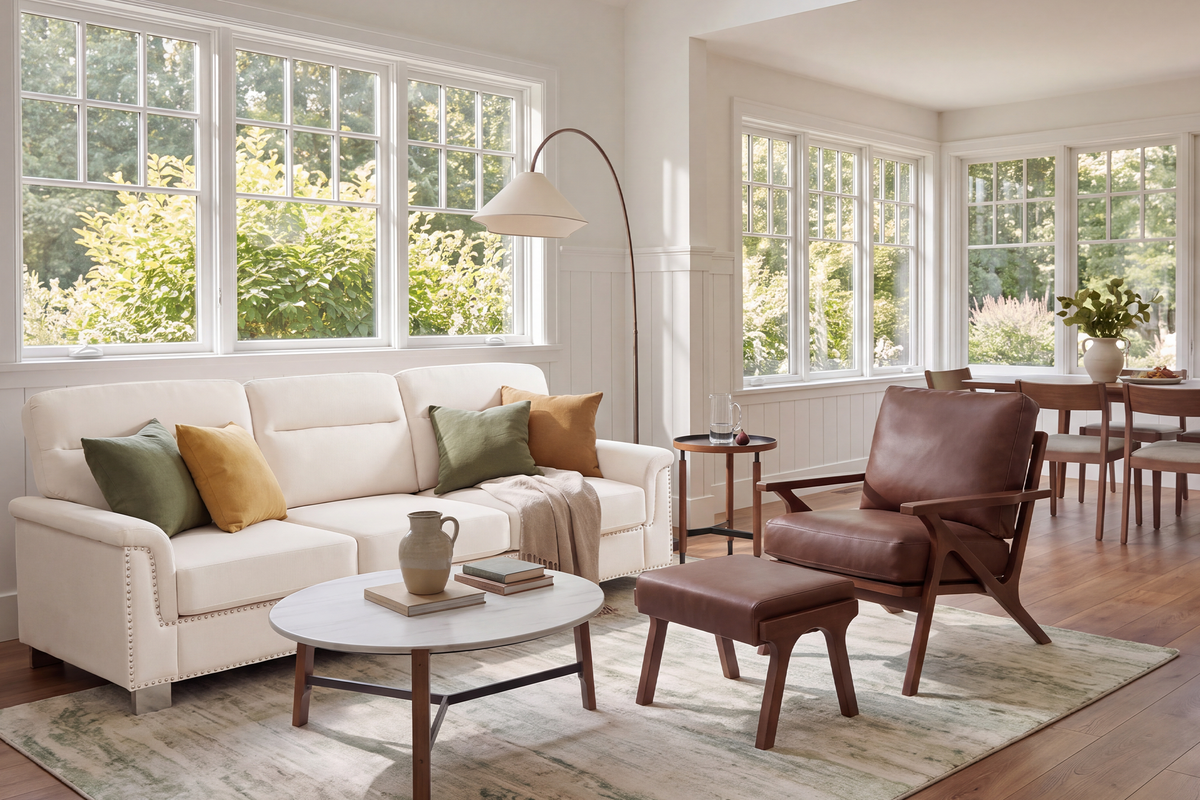
Why the psychology of furniture starts with the seat you use most
If your living room feels tense, cold, or oddly tiring, the fix is often not more décor. The psychology of furniture usually comes down to support, texture, scale, and movement through the room. For a calmer setup, an upholstered sofa with resilient cushions, softened lines, and balanced proportions works better than seating that looks sharp but feels rigid.
Research supports the broader idea. A qualitative study indexed by PubMed found that furniture contributes to physical comfort, emotional well-being, and a stronger sense of home. That matters in practical terms: when your main seating feels better, the whole room usually becomes easier to use and easier to enjoy.
What parts of furniture actually change how a room feels
A room affects you in two ways at once. First, your body reacts to how a piece supports you. Second, your eyes read shape, density, and spacing before you even sit down. That is the starting point for understanding how furniture affects mood in everyday life.
Support changes how long you want to stay
Support is not just an ergonomic topic for office chairs. It also matters in living rooms, where poor seating can create low-level tension in your shoulders, hips, or lower back. OSHA notes that neutral body positioning reduces stress and strain on the musculoskeletal system, which is a useful principle for home seating too.
When you assess support, focus on:
- Cushion rebound instead of initial softness alone
- Arm height that lets your shoulders relax
- Seat depth that does not force slouching
- Back support that feels stable during longer sitting sessions
Texture changes emotional temperature
Texture often shifts mood faster than color. Smooth, flat surfaces can look neat, but they may also read as cool or distant. By contrast, tactile upholstery adds visual depth and makes a room feel more settled.
In practice, texture influences mood through:
- Touch comfort when you first sit down
- Light reflection, which changes perceived warmth
- Visual softness across larger surfaces
- Noise feel, since plush textiles often make a room seem less harsh
Scale affects pressure and ease
Furniture scale can calm a room or crowd it. Oversized pieces may feel protective and cozy in one layout, then heavy and stressful in another. Undersized seating can preserve openness, yet still leave the room emotionally thin.
A useful scale check includes:
- Whether main walkways stay open
- Whether the sofa width suits the wall length
- Whether the furniture leaves enough negative space, meaning visual breathing room
- Whether the piece looks grounded without dominating the room
Style cues set the room’s social tone
Furniture also sends social signals. Rolled arms, tufting, trim, and upright posture lines can make a room feel formal, intentional, or traditional. Lower profiles, deeper seats, and modular shapes usually feel more casual and lounge-oriented.
That social tone often shows up in four mood buckets:
- Restful
- Social
- Formal
- Energized
The psychology of furniture is strongest when those signals match how you actually use the room. A conversation-focused room benefits from clearer visual structure. A movie room or family lounge usually benefits from softer forms and more relaxed seating positions.
How to use the psychology of furniture in a living room
Once you know what changes mood, the next step is matching furniture to behavior. This is where living room furniture mood becomes a practical design tool instead of a vague style idea.
Start with the behavior the room should encourage
A room usually feels best when the furniture supports one primary behavior. That could be long conversations, TV watching, reading, or shared family downtime. When the behavior and the seating disagree, the room often feels off even if it looks attractive.
Use this quick behavior map:
- Conversation-first: moderate seat depth, supportive back, visible structure
- Reading-first: supportive cushions, a softer fabric, room for side lighting
- TV relaxation: wider seating, forgiving cushion response, comfortable arm support
- Family lounging: sectional layout, flexible ottoman use, deeper relaxation posture
Use texture to control comfort without rebuilding the room
If a room feels sterile, echo-heavy, or emotionally flat, upholstery can do more than accessories. Texture changes the emotional read of the largest furniture surfaces, which is why fabric choice carries so much weight in how home design affects emotions.
A warmer mood usually comes from:
- Velvet, chenille, or other tactile upholstery
- Rounded edges instead of sharp profiles
- Cushions with visible softness but clear structure
- Finishes that absorb light rather than bounce it harshly
Let layout support mental ease, not just symmetry
You do not need a large room to improve furniture layout and mental well-being, but you do need clear movement. A calm layout reduces friction because people can sit, stand, and pass through the room without constant adjustment.
Check these layout signals:
- The main walkway is not blocked by corners or ottomans
- The sofa does not force every other piece against the wall
- Side tables are easy to reach from the main seat
- The room has a focal point, but not too many competing ones
A visually balanced room often feels emotionally balanced because the eye can settle. That is one reason the sofa is usually the highest-impact purchase in a mood-focused update.
How to choose mood-focused furniture without guessing
At this stage, the goal is not to chase a trend. The goal is to read your room clearly, then match the furniture traits to the emotional effect you want.
What to check before you buy
A sofa may look right online and still feel wrong in the room. The fastest way to avoid that mismatch is to review the body experience and the visual experience together.
Use this buying checklist:
- Measure wall width and walkway clearance first
- Match seat style to the room’s main activity
- Decide whether you need formal structure or lounge softness
- Choose a fabric that supports the desired mood
- Check weight capacity and frame materials for daily-use durability
- Read return terms before assembly
Chairus publishes material details, dimensions, care guidance, and support policies on its product pages, which makes comparison easier if you are narrowing by use case rather than by trend name.
A quick comparison table
| Sofa type | Mood signal | Best for | Space pressure | Texture impact |
|---|---|---|---|---|
| Velvet 3-seater | Balanced, warm, structured | Daily living rooms | Moderate | High |
| Chesterfield loveseat | Formal, intimate, decorative | Small rooms or accent seating | Low to moderate | High |
| L-shaped chenille sectional | Casual, enveloping, social | Family rooms and TV zones | High | Moderate to high |
Service details that matter for U.S. shoppers
A mood-driven purchase still needs practical guardrails. Chairus states that orders ship free from U.S. warehouses, generally from the nearest warehouse, and many products ship within 2 business days. Chairus also lists a 30-day return or exchange window and a 1-year warranty, although non-quality returns can involve shipping responsibility and additional fees if the item has been assembled, so those terms are worth reviewing before setup.
Common mistakes that make a room feel emotionally off
Many rooms feel uncomfortable for reasons that are hard to name. Usually, the issue is not one bad piece. It is a mismatch between support, shape, texture, and room scale.
Mood mistakes worth fixing first
These problems show up often:
- A plush fabric paired with a cramped traffic path
- A formal sofa used in a highly casual family room
- Deep lounge seating in a conversation-first layout
- Furniture that looks elegant but creates posture strain
- Dark, visually heavy upholstery in a room that already feels tight
The result is often subtle. You may use the room less, shift positions more often, or feel restless without knowing why.
Better moves for a calmer room
Small corrections usually outperform a full redesign. If the room feels emotionally flat, start with the largest seating piece and build outward.
A good adjustment sequence looks like this:
- Reconfirm the room’s main purpose.
- Measure whether the current layout protects movement.
- Upgrade the seating texture before replacing smaller décor.
- Choose support that encourages longer, easier sitting.
- Use color depth to fine-tune formality and warmth.
The mood-first rules that matter most
Mood usually improves fastest when you treat seating as the emotional anchor of the room. Color matters, but posture, softness, and room flow usually matter first.
Best practices
- Keep main walkways open and intuitive
- Choose cushion support with some rebound, not just plushness
- Use tactile upholstery to warm up flat-looking rooms
- Match silhouette to the room’s main social behavior
- Let one large seating piece set the emotional tone
Pitfalls to avoid
- Buying only for looks and ignoring seat feel
- Oversizing a sofa for a narrow room
- Mixing formal and casual signals without a plan
- Treating accessories as the solution when the sofa is the real issue
- Skipping return-policy details until after assembly
FAQ
How does furniture affect mood in a home?
Furniture affects mood by shaping both body comfort and visual order. Supportive seating reduces physical tension, while balanced scale and softer textures make a room feel calmer and easier to use. The biggest shifts usually come from the main sofa because it controls posture, touch, and the room’s focal point at the same time.
What kind of sofa creates a more calming living room?
A calming living room usually benefits from a sofa with moderate visual weight, supportive cushions, and a soft surface such as velvet or chenille. Rounded or curved arms can also help because they soften the room’s lines. For a balanced result, an 80- to 84-inch sofa often works well in medium-size rooms where you want both comfort and a clear layout.
Does velvet upholstery really make a room feel warmer?
Yes, velvet usually makes a room feel warmer because it adds tactile softness and deeper light absorption than flatter fabrics. That combination makes the seating look richer and less sterile, especially in living rooms with hard flooring or minimal décor. It works best when the rest of the room already has enough space for the sofa’s visual weight.
How should furniture size relate to the emotional feel of a room?
Furniture size should support both comfort and circulation if you want the room to feel calm. Pieces that are too large can compress walkways and create visual pressure, while pieces that are too small can leave the room feeling disconnected or unfinished. As a starting point, keep the main walking path clear and choose the largest seat that still lets the room breathe.