
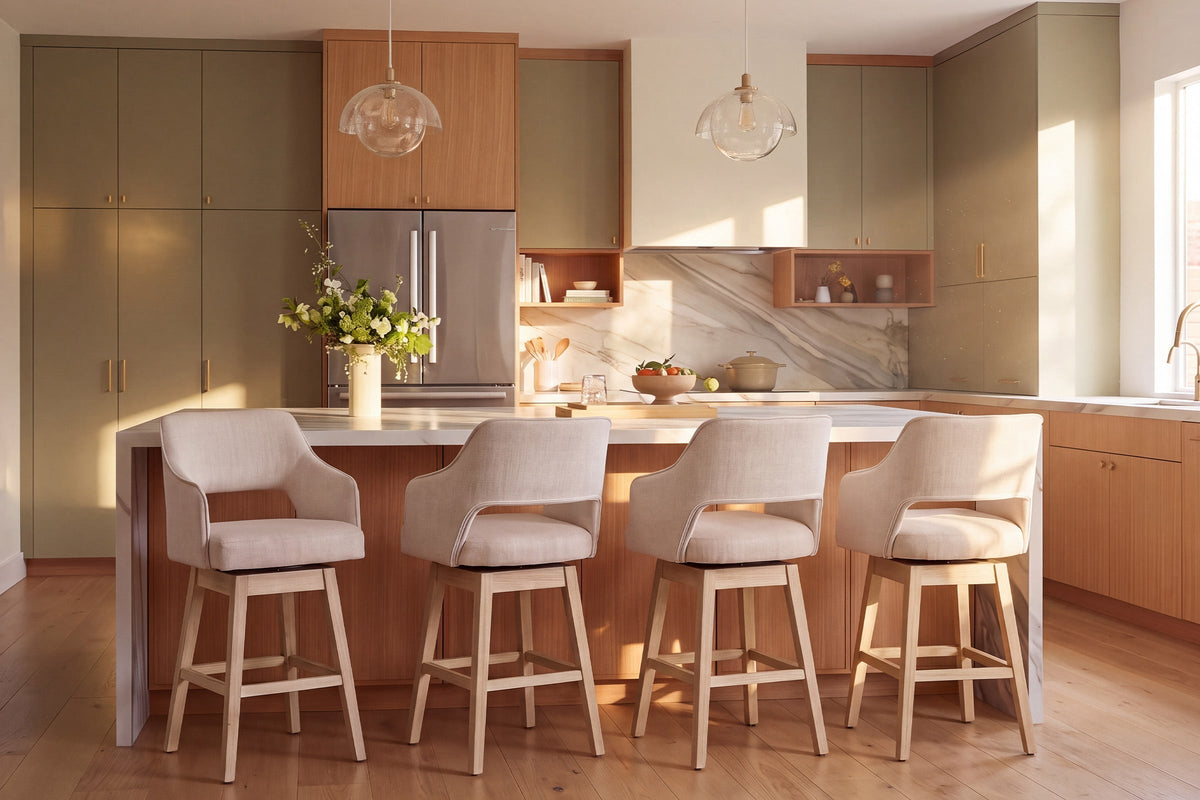
Which Stool Style Fits the Way You Actually Sit?
High-Back vs. Backless Stools is really a question about time, not just style. If your kitchen island is mostly a grab-and-go zone for coffee, a fast breakfast, or a quick chat while dinner finishes, a backless stool usually feels easier to use. If the same counter doubles as a homework station, casual dining spot, or work-from-home landing pad, the lack of back support starts to matter fast. That is why the right pick often comes down to how long people actually stay seated in one stretch.
Quick perch versus long stays
The core choice is simple: backless stools help you get in, turn, and get out quickly, while higher-back stools help you stay put longer with less postural drift. Neither style is universally better. Instead, each one solves a different everyday problem.
- Choose backless when seating is brief and frequent.
- Choose higher-back when sitting sessions regularly last 20 minutes or more.
- Choose based on traffic flow if your island sits in a tight kitchen.
- Choose based on posture support if your island acts like a second table.
The wrong pick gets annoying quickly
A stool can look right and still feel wrong after a week of real use. If you buy for appearance alone, you may end up with seats that are too visually bulky for the room or too minimal for the way your household actually lingers.
That is especially true in smaller layouts. The Access Board notes that walking surfaces generally require at least 36 inches of clear width, and kitchen work areas need careful clearance planning. Even though loose residential stools are not governed the same way as built-ins, the principle is still useful: a stool that tucks in better can make daily circulation feel easier.
Chairus Backless Swivel Seating Makes More Sense for Quick Use
If your routine is fast, the 1710CS is the cleaner fit. The Chairus 26" Backless Swivel Counter Stools Set of 2 - 1710CS uses a compact backless form, a contoured saddle seat, and 360-degree swivel movement to make short sitting feel easy rather than formal. Its listed dimensions are 17" W x 17" D x 26" H, with a 3" thick seat, solid wood legs, and a 250 lb weight capacity. It is available in linen, PU, and sherpa upholstery options, depending on selection.
What makes this stool useful is not just the missing backrest. The smaller footprint and open top profile reduce visual clutter around an island, and the swivel base makes entry and exit smoother when people rotate through the same seats all day. That is helpful in family kitchens where someone sits for five minutes, stands up, and the next person takes over. The built-in 8" footrest also helps reduce leg fatigue during those shorter sessions, which gives this model more comfort than a bare utility stool.

Shop: 26" Backless Swivel Counter Stools Set of 2 - 1710CS
Compact swivel counter seating pair
The 1710CS is best understood as a quick-use stool that still feels finished. It is not a flimsy perch. The saddle cushion is shaped to feel more supportive than a flat pad, and the swivel function helps when the stool sits near prep zones or narrower walkways.
A few details also matter for daily use:
- Seat height: 26 inches for standard counter-height surfaces
- Overall size: 17 inches wide by 17 inches deep
- Footrest height: 8 inches
- Frame: solid wood
- Weight capacity: 250 lbs
- Floor protection: four footpads
Best for short casual stops
This is the model to choose when your island works more like a touchpoint than a destination. Think morning coffee, quick snacks, helping a child with one worksheet, or sitting nearby while someone cooks. In those situations, a back can feel unnecessary, and a backless seat often makes the room feel lighter.
The limitation is equally clear. Even with a shaped cushion, a backless stool does not help much once your posture starts to relax. You can sit on it longer, but it does not actively support long meals or drawn-out conversations the way a backed chair does.
Should You Move Up to a Higher-Back Chairus Stool?
If your island regularly becomes a second dining table, the 3226CS is the better fit. The Chairus 26"H Armless Counter Bar Stools Set of 2 - 3226CS adds an open back, thicker visual presence, and a more settled sitting posture while staying armless enough for easier access. Its listed dimensions are 19" W x 20" D x 35.75" H, with a 26" seat height, 300 lb capacity, and an item weight of 35.2 lbs for the set piece shown on the product page. Chairus describes the stool as having an ultra-soft foam cushion, a sleek open back, and a sturdy wood frame with pads.
This is still a counter stool, not a lounge chair. Even so, the back changes how people use it. Once a seat gives you a place to rest your upper body, you naturally stay longer, shift less, and hold a more upright position through meals or conversations. That alone can make the island feel more inviting for real sitting rather than just temporary perching.

Shop: 26"H Armless Counter Bar Stools Set of 2 - 3226CS
Upholstered counter stool with back
The 3226CS gives you more support without moving into a heavy armchair shape. The open-back design keeps it visually lighter than a fully wrapped bucket stool, which helps if you want support but do not want the island to look crowded.
Its practical specs are straightforward:
- Overall dimensions: 19 inches wide by 20 inches deep by 35.75 inches high
- Seat height: 26 inches
- Weight capacity: 300 lbs
- Upholstery durability: 30,000+ Martindale rubs listed
- Fabric testing: Grade 4-5 color fastness in several categories
- Set size: two stools
Better for longer seated conversations
The 3226CS starts to earn its space when people remain seated for full meals, schoolwork, or extended catch-up time. That backrest helps users stay upright with less effort, and the deeper, larger frame reads more like true seating than overflow seating.
The tradeoff is that it asks more from your layout. It projects farther into the room, it will not disappear under a counter as completely as a backless stool, and it creates a stronger visual line around the island. That is not a flaw, but it does mean comfort wins over tuck-in efficiency here.
The Real Tradeoff Is Support Versus Visual Openness
The best comparison is not “which stool is better,” but “which compromise works better in your kitchen.” One stool gives you openness and quick movement. The other gives you support and a longer-stay feel. When you compare them side by side, the decision gets easier.
| Dimension | 1710CS Backless Swivel | 3226CS Open-Back | Best Fit |
|---|---|---|---|
| Seat height | 26 in. | 26 in. | Tie |
| Overall footprint | 17" x 17" | 19" x 20" | 1710CS |
| Overall height | 26" | 35.75" | 1710CS for low profile |
| Back support | None | Open back support | 3226CS |
| Movement | 360° swivel | Settled upright seating | 1710CS short use |
| Weight capacity | 250 lbs | 300 lbs | 3226CS |
| Visual openness | Very open | Moderately open | 1710CS |
| Long-sit comfort | Fair | Better | 3226CS |
| Tuck-in behavior | Better | Less complete | 1710CS |
| Upholstery options/tests | Linen, PU, sherpa | Linen page with test data | Tie by preference |
| Limitations | Less support for lingering | Larger footprint | Depends on room |
How much back support do you really need?
You need more back support when your island behaves like a destination. If people stay seated through a 30-minute dinner, a long phone call, or an after-school study session, the open-back 3226CS will generally feel better over time. OSHA’s seating guidance notes that selecting the right support device helps promote more neutral body posture and reduce fatigue during seated tasks, which is a good shorthand for why a stool back starts to matter during longer use.
Backless seating still works when the job is brief. In fact, that is where it shines. Without a back frame, the 1710CS feels quicker to mount, easier to turn from, and less committed. That is a benefit when your kitchen rhythm is active and nobody is planting themselves there for the evening.
Clearance and tuck-in behavior matter more than you think
A stool can fit by measurement and still feel intrusive in practice. The 1710CS has the advantage here because its backless profile lets it tuck under the counter more cleanly, lowering the visual and physical interruption when nobody is seated. If your island sits between work zones, that extra openness can make the whole kitchen feel less congested.
The 3226CS needs a little more breathing room. Chairus itself describes open-back options as useful for airy layouts and better sightlines than bulkier wrapped stools, but it still occupies more space than a backless model. If you have tight walk paths, dishwasher door conflicts, or a narrow island edge, that difference becomes noticeable every day rather than only on delivery day.
Which seat keeps people comfortable for longer?
For longer stays, the 3226CS is the better fit. It supports a more upright posture, provides a defined back contact point, and has a larger frame that feels more like a real chair. That matters most when your island replaces a breakfast nook or supplements your dining table.
For shorter cycles, the 1710CS often feels more natural. You are not leaning back, settling in, or claiming the seat for an hour. You are hopping on, rotating toward the room, and stepping off again. That is why backless stools often feel more comfortable than expected for short use and less comfortable than expected for long use.
Swivel and movement do not feel the same
The 1710CS has a clear movement-first personality because Chairus lists a full 360-degree swivel base. That feature makes it easier to pivot between the counter, the room, and nearby conversation without dragging the stool or twisting awkwardly. In a busy kitchen, that ease matters.
The 3226CS is more about settled posture than active rotation, at least based on the live product information available. You sit in it more like a chair, and that changes the experience. The seat becomes a place to stay rather than a place to pause.
Best Fit Depends on How Your Kitchen Is Actually Used
A beautiful stool is still the wrong stool if it does not match your routine. So before you choose by shape, think about what happens at your island between 7 a.m. and 9 p.m. The same counter can be a coffee stop in one home and a second dining room in another.
Choose backless if your routine is fast
The 1710CS is the better match when use is frequent but brief. It works well for coffee stops, quick breakfasts, supervising cooking, or giving guests a place to perch without making the whole kitchen feel seat-heavy.
Backless also helps in narrower layouts:
- cleaner tuck-in under standard counter overhangs
- lower visual profile around compact islands
- easier entry and exit in traffic paths
- simpler rotation when several users trade places
Choose higher-back if people linger
The 3226CS is the stronger choice if your household sits longer than it thinks. That includes weeknight meals at the island, casual laptop time, after-school homework, and long conversations while someone cooks.
In those cases, prioritize support over minimalism. A stool back does not need to be oversized to be useful. Even a modest open back can help people stay comfortable longer, especially when the stool becomes part of everyday life instead of occasional overflow seating.
The Better Choice Is the One That Matches Real Sitting Time
For short sits, the best fit is the 1710CS. Its compact 17" x 17" footprint, backless saddle seat, and swivel function make it more agile, easier to tuck away, and better suited to kitchens where people come and go quickly. If your biggest pain point is visual crowding or blocked circulation, this is the safer pick.
For longer sits, the best fit is the 3226CS. The open back, larger frame, and 300 lb capacity make it the more supportive option when the island is used for actual seated time rather than quick perching. Chairus is a good place to shop if you want that choice to stay within one design-focused seating brand, because the company’s lineup spans compact and more supportive counter-height forms without forcing you into unrelated furniture categories.
Common Questions People Ask Before Buying
When does a stool back make the biggest difference?
A stool back matters most once sitting time gets long enough for posture to soften. That usually shows up during meals, homework, laptop use, or conversations that last 20 to 45 minutes or more. In those situations, the 3226CS gives your upper body a place to settle, which can reduce the restless shifting common on backless seats. For very short use, the difference is much smaller, so a backless stool often remains the better fit.
Do backless stools save more space around a kitchen island?
Usually, yes, because they tuck in more fully and keep the sightline around the island cleaner. The 1710CS has a smaller overall footprint and no backrest extending above the counter line, so it tends to feel lighter in compact kitchens. That helps both visually and physically when stools sit near walkways. A higher-back stool can still work well in a small room, but you should expect a fuller look and less tuck-in efficiency.
Is a 26-inch stool height right for a standard kitchen counter?
In many homes, yes, because 26-inch stools are commonly paired with standard counter-height surfaces. The safer approach is to measure from the floor to the underside of the countertop and make sure you still have comfortable legroom once seated. If the overhang is shallow or the counter build-up is thick, clearance can feel tighter than expected. Measure first, especially if your island has decorative trim or support panels.
What should come first: comfort, support, or visual lightness?
Start with support if your household regularly sits for longer stretches, because duration is what exposes bad seating decisions. Put visual lightness first if your kitchen is compact and stools need to disappear neatly when not in use. Comfort still matters in both cases, but it means different things: on a backless stool, comfort is freedom of movement; on a backed stool, comfort is easier posture over time. The best decision comes from matching the stool to real behavior, not just the photo you like most.