
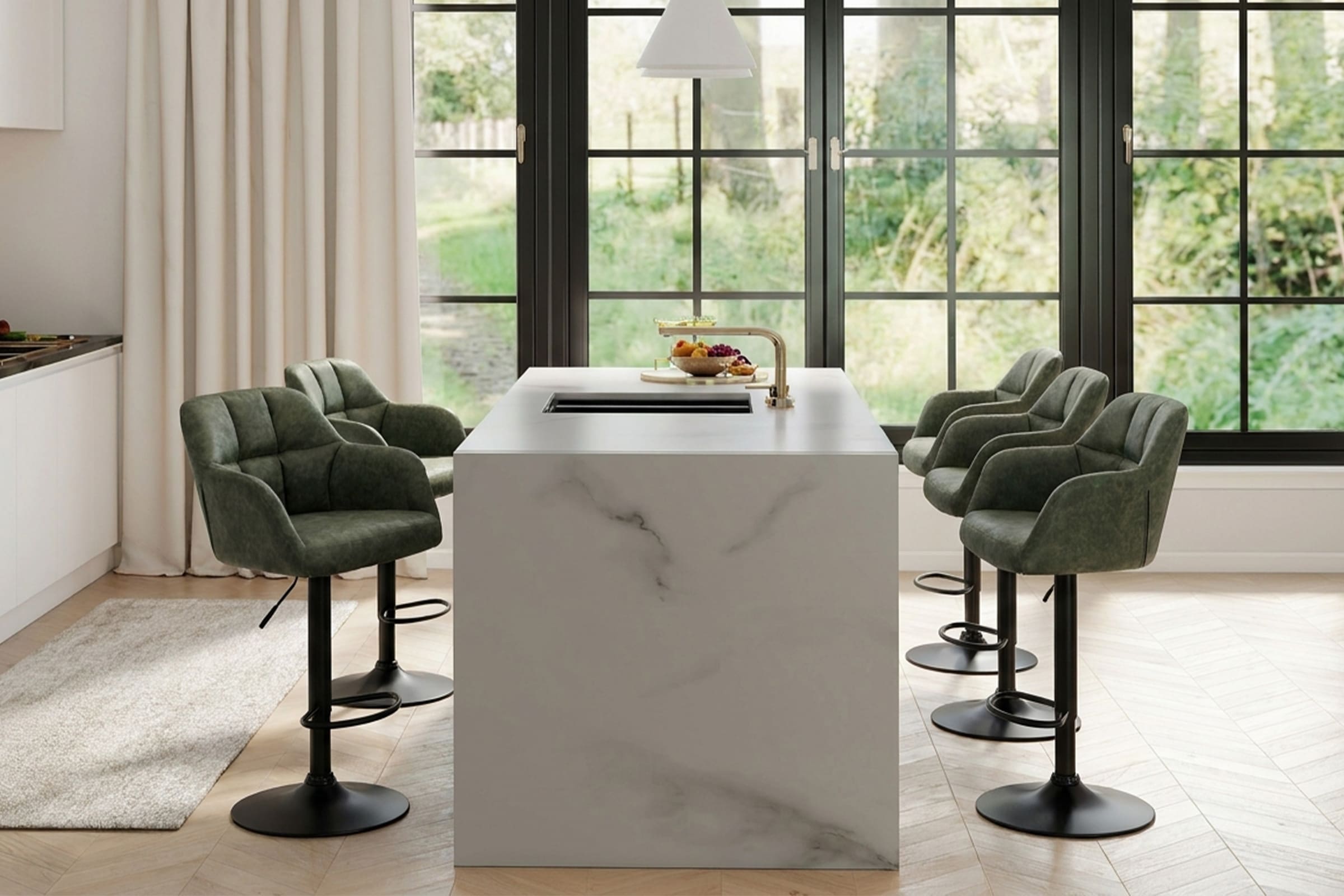
Understanding Fixed and Swivel Bar Stools
A bar stool usually feels wrong before it looks wrong. You notice it when someone has to twist sideways to sit down, when two seats knock into each other at the island, or when the stool seems steady in the photo but awkward in real use. That is why the fixed vs swivel bar stools decision matters more than many shoppers expect. In daily life, the better choice is not only about style. It is about how the stool behaves when people sit, turn, stand, and move around the room.
For most homes, the real question is not which type is universally better. It is which one feels more stable in your layout, at your counter height, and with your household routine. This guide breaks that down in plain language, starting with what stability actually means, then moving into sizing, spacing, comfort, and daily use. Along the way, you will see where Chairus models fit naturally, especially if you are comparing upholstered kitchen island bar stools, compact counter stools, and swivel designs within one collection.
What Makes a Bar Stool Feel Stable?
Stability sounds simple, but shoppers usually mean three different things at once. A stool can feel “stable” because it does not wobble, because it is easy to get on and off, or because it fits the room without bumping into cabinets and nearby seats. When you separate those ideas, the fixed vs swivel bar stools comparison becomes much easier.
Structural stability
This is the foundation of the stool itself. It covers frame strength, joinery, weight distribution, and whether all legs make even contact with the floor. A wide, balanced footprint and a solid footrest usually help a stool feel more planted. OSHA notes that slips, trips, and falls are a leading cause of injuries, which is a useful reminder that even a well-designed seat can feel less secure on uneven or slippery flooring.
- Look for a balanced leg stance rather than a narrow visual profile only
- Check whether the footrest feels firmly integrated into the frame
- Confirm the listed weight capacity and overall dimensions
- On hard floors, use floor protectors so all legs stay level
User stability
This is how secure the stool feels once a person actually uses it. A fixed seat often feels more anchored because there is no intentional motion. A swivel seat can still feel very secure, but it introduces controlled rotation, so the user experience changes. For some people, especially those who dislike dragging a stool backward, that movement improves confidence rather than reducing it.
A good example is the Chairus [26" Swivel Wooden Backrest Counter Height Counter Stool - 3193CS]. It pairs a 360-degree swivel with an 18.5" W x 18.5" D frame, a 26.25" seat height, and a 300 lb capacity, which shows how a swivel stool can still be built around a compact, supportive structure.
Layout stability
This is the one shoppers miss most often. A stool may be sturdy on its own but still feel unstable in practice if the room is too tight. Clearance affects how people slide in, rotate, rest their feet, and step away. That is why stable bar stools depend on both product design and floor plan.
Core terms to know first
Before you compare options, keep these terms straight:
- Fixed seat construction: the seat stays in one direction and does not rotate
- Swivel seat mechanism: the seat rotates, often 180 or 360 degrees depending on the design
- Counter-height stool: usually suited to counters around 34 to 40 inches high
- Bar-height stool: usually suited to taller bar surfaces around 40 to 42 inches high
- Clearance and spacing: the room each stool needs for knees, elbows, and entry movement
Fixed or Swivel: Which Works Better Day to Day?
If you want the shortest answer, fixed stools usually feel more motion-free, while swivel stools usually feel easier to live with in active spaces. The best choice depends on whether you value a planted seat or easier movement more.
Access and movement
This is where swivel stools usually win. When stools are lined up at an island, people often do not want to pull the whole seat backward just to stand up. A swivel design lets them turn out more naturally, which can reduce scraping and side-stepping in busy kitchens. Reference guidance from the source articles consistently points in this direction, and Chairus makes the same practical case in its recent kitchen-island bar stool guidance.
By contrast, a fixed bar stool for kitchen seating can feel calmer and more predictable. There is no turn in the seat, so people who prefer a firmly facing position often like the experience better. Fixed stools also make sense in compact layouts where you want every seat to stay visually aligned.
- Swivel stools: easier for sit-turn-stand use, especially in social spaces
- Fixed stools: better for shoppers who want no seat rotation at all
- Swivel stools: helpful when stools are hard to slide backward
- Fixed stools: often better when a quiet, anchored feel matters most
Felt stability in everyday use
This is where people often assume fixed always wins. In reality, a fixed stool usually feels more stable only if you define stability as “no movement in the seat.” If you define stability as easy and controlled entry, a well-built swivel can perform just as well or better.
The Chairus [27" Open Back Swivel Counter Stools - 6550CS] illustrates that point. They use a 360-degree swivel seat, measure 20" W x 20.75" D x 39.75" H, have a 27.25" seat height, and support up to 300 lbs. Those specs matter because swivel stool stability improves when the frame is proportionate and the footrest and back support work together.
Wear, maintenance, and noise
Fixed stools are simpler. Fewer moving parts usually means fewer long-term maintenance points. That does not make swivel stools fragile, but it does mean mechanism quality matters more. If hardware is poor, you may notice looseness or noise sooner.
Where Chairus fits naturally
The broader Chairus [Counter & Bar Stools collection] is useful because it lets you compare multiple seat types within one visual language. You can move from compact backless options to upholstered swivel models to more anchored silhouettes without changing brands, which makes it easier to judge how seat height, back shape, and base footprint affect swivel stool stability and comfort.
How to Choose for Your Kitchen Island or Home Bar
The easiest way to avoid a bad purchase is to decide in the right order. Measure first, then map spacing, then choose between fixed and swivel based on how your household actually uses the space. This counter stool buying guide works whether you need two stools at a breakfast counter or a full row at a large island.
Step 1: Match stool height first
Wrong height makes any stool feel unstable fast. If the seat is too tall, knees crowd the counter. If it is too low, the sitter perches upward and loses support.
- Measure from the floor to the underside or working surface of the counter
- For most kitchen island bar stools, leave about 10 to 12 inches between the seat and the counter underside
- Counter stools usually fit 34 to 40 inch counters
- Bar stools usually fit taller 40 to 42 inch surfaces
The Chairus [Ealson Modern Swivel Bar Stools Set of 2 - 5117] is a good example of why specs matter. Its adjustable swivel version measures 22" W x 23.5" D x 36.25" to 45" H with a seat height range of 25.5" to 34.25" and a 300 lb capacity. That makes it more flexible than a fixed-height stool when your surface or seating preference falls between standard categories.

Step 2: Plan spacing realistically
Bar stool spacing changes how stable the whole setup feels. Even strong stools feel awkward if users keep hitting elbows or twisting around neighboring seats.
A practical starting point is to count your usable counter width, then divide based on seat width plus elbow room. Swivel stools usually need more functional clearance than fixed stools because the user turns as they get in and out. On family islands, that extra movement matters more than it does in a formal bar zone.
Step 3: Choose by household behavior
The right stool is often obvious once you think about your routine.
- Kids and quick snacks often benefit from easy entry
- Frequent hosting usually favors swivel movement
- Quiet meals and tight rows often favor fixed seating
- Small kitchens reward compact footprints and cleaner alignment
Reuters and broader home design reporting in 2025 and 2026 have reflected a strong function-first approach in kitchen planning, and that trend fits this category well: stools work best when layout logic comes before appearance.
Which Factors Matter Most Before You Buy?
Most shoppers start with style, but the buying order should be different. Fit comes first, then frame strength, then real-use comfort, and only then finish or visual softness. If you rank factors this way, you avoid the most common return-worthy mistakes.
Fit and proportions
This is the biggest checkpoint because poor height throws off comfort immediately.
- Seat-to-counter clearance should feel natural, not cramped
- Back height should not visually overwhelm a compact island
- Deep seats can be comfortable, but they need more room behind the knees
- Narrow stools save space, but they should still support the sitter well
Factor 2: Performance in real use
This is where fixed vs swivel bar stools becomes practical rather than theoretical.
| Decision factor | Fixed stools | Swivel stools |
|---|---|---|
| Entry and exit | More stable, but may require pulling back | Easier turning with less floor dragging |
| Compact layouts | Usually easier to align tightly | Needs more functional clearance |
| Motion feel | No seat rotation | Controlled seat movement |
| Maintenance | Fewer moving parts | Mechanism quality matters more |
| Social use | Better for forward-facing seating | Better for conversation and turning |
Factor 3: Maintenance and material choice
If your stools live in a high-use kitchen, upholstery and cleanability matter. The Chairus collection includes linen, PU, velvet, sherpa, chenille, terry, and wood options, which is helpful because maintenance needs change with the room. Linen can feel softer and more relaxed, while PU is often easier to wipe clean in busy kitchens.
Best Practices and Mistakes to Avoid
A good stool choice usually comes from small practical checks, not one dramatic feature. Stable bar stools feel reliable when the dimensions, materials, and room layout support each other.
Best practices
Start with the surface height, not the finish. Then confirm seat height, spacing, and foot support before you compare color or upholstery.
- Measure the counter before shopping
- Prioritize a usable footrest, especially for longer sitting sessions
- Check listed dimensions, not just photos
- Leave extra room for swivel motion in active households
- Test your likely entry path, not only the front view
- Use floor protectors if your surface is slick or slightly uneven
Common pitfalls to avoid
The biggest mistake is assuming one stool type is always more stable. In reality, fixed stools can feel awkward if they are too tall, too narrow, or poorly spaced. Swivel stools can feel excellent if the mechanism is solid and the layout allows enough room.
CPSC regularly highlights how tip-over and collapse hazards can cause serious injuries in unstable products, which is a useful reminder to take frame integrity seriously in any seat you bring into a family space.
- Do not buy by looks alone
- Do not ignore stool depth when planning walkways
- Do not force three stools where only two fit comfortably
- Do not assume swivel stools work in the same spacing as fixed stools
- Do not overlook capacity, hardware, and footrest design
Final Takeaway: The Better Choice Depends on Your Space
If you define stability as a still, planted seat with a compact footprint, fixed stools often feel more stable. If you define stability as easier entry, less dragging, and smoother daily movement, a well-built swivel stool may feel better in real use. That is the core answer to fixed vs swivel bar stools: the more stable option depends on how your room works, not just how the stool is built.
Measure first, plan bar stool spacing second, and then compare seat style based on daily behavior. If you want to explore different silhouettes, materials, and height categories in one place, the Chairus is a practical starting point for kitchens, islands, and home bars.
FAQ
Are fixed bar stools always more stable than swivel bar stools?
No, fixed bar stools are not always more stable than swivel bar stools. A fixed seat often feels more planted because it does not rotate, but overall stability also depends on frame width, footrest support, seat height, and even floor contact. A well-built swivel stool with a balanced footprint and solid hardware can feel highly secure in normal daily use. The better test is how the stool performs in your exact layout and routine.
Do swivel bar stools need more space between seats?
Yes, swivel bar stools usually need more space between seats. The turning motion creates extra functional clearance needs during entry, exit, and conversation, even if the stool itself is not much wider than a fixed model. In most kitchens, you should plan more room for elbows and turning paths with swivel seating than with fixed seating. If spacing is tight, a fixed stool often works more cleanly.
How do I know if I need counter-height or bar-height stools?
You know by measuring from the floor to the underside or usable top height of the surface. Most counter-height stools work best with counters around 34 to 40 inches high, while bar-height stools fit surfaces around 40 to 42 inches. A good target is roughly 10 to 12 inches of space between the seat and the counter underside. When that gap is wrong, even comfortable stools feel awkward and less stable.
Are swivel stools less durable because they have moving parts?
Not necessarily, but swivel stools do require more attention to mechanism quality. The added motion means hardware, bearings, and attachment points matter more than they do on a fixed stool. A strong swivel design can last very well when the frame is solid and the seat is properly supported. Fixed stools are simply more straightforward because they have fewer components to wear over time.
What matters more for kitchen islands: comfort or stability?
Comfort and stability matter together because each affects the other. A stool that looks sturdy but has poor seat height, no supportive footrest, or too little back support can feel awkward within a few minutes. On the other hand, a plush stool that crowds the island can create unstable entry and exit patterns. The best kitchen island bar stools balance support, clearance, and movement for your daily routine.
What type of stool is better for families and entertaining?
Swivel stools are often better for entertaining, while fixed stools can be better for compact or more controlled family use. In social layouts, swivel seats make it easier for people to turn, talk, and get in or out without scraping the floor. In smaller kitchens, fixed stools often keep traffic cleaner and reduce unnecessary motion. The best choice depends on whether your space functions more like a busy gathering zone or a simple everyday breakfast spot.