
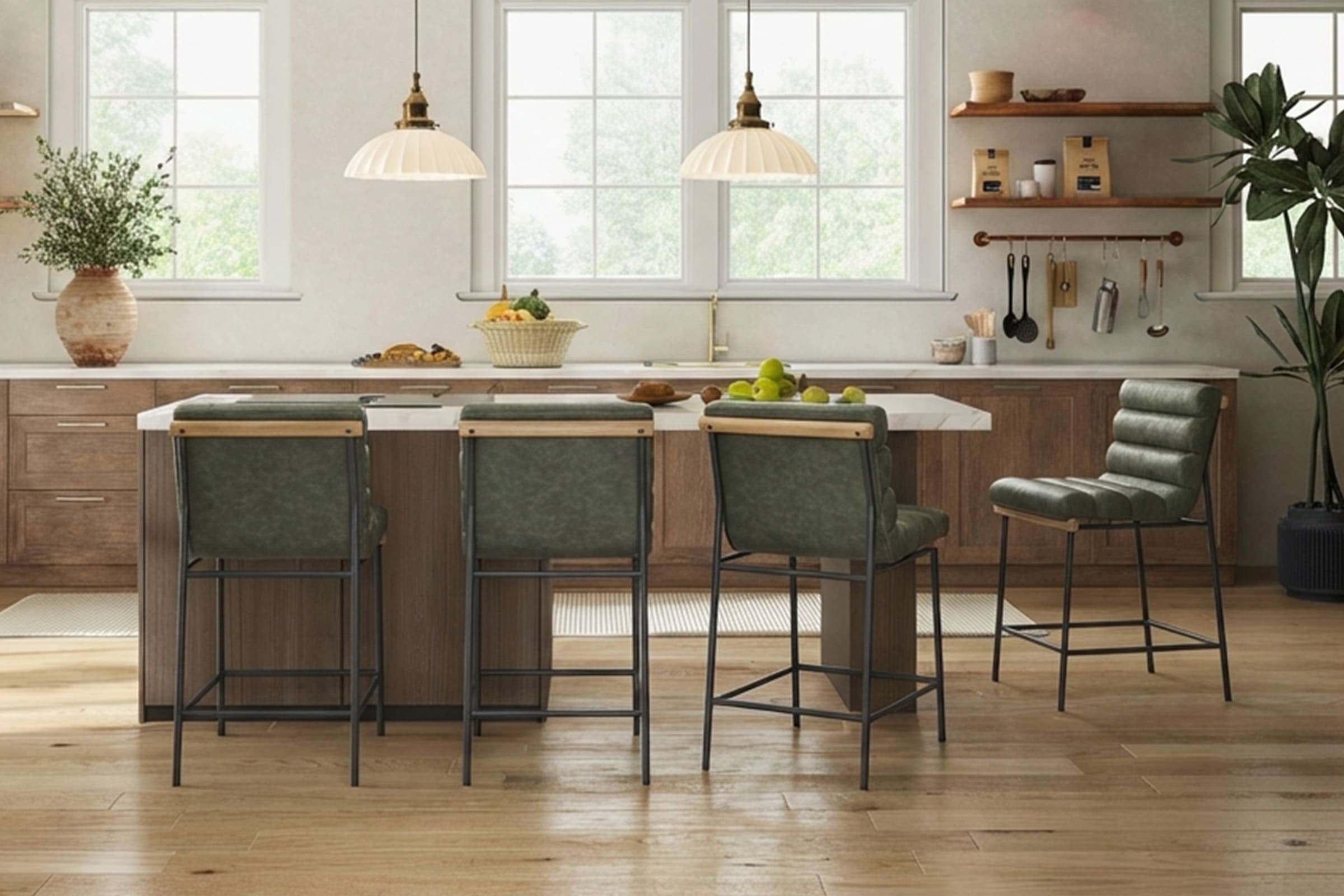
Swivel vs Fixed Bar Stools
Busy breakfasts, after-school snacks, and quick weeknight dinners all happen at the kitchen island, so your bar stools end up doing more work than most people expect. If you have kids at home, the wrong stool can add one more thing to monitor: spinning seats, awkward climbing, bumped knees, and stools that always seem to sit in the way. Style matters too, because a modern kitchen looks best when the seating feels intentional rather than crowded.
This guide gives the short answer first: fixed bar stools are usually the safer pick for homes with young children, while swivel bar stools are often easier for adults and guests to use every day.
From there, the better choice depends on how your kitchen flows, how much clearance you have, and whether you want your seating to feel calm and architectural or flexible and social. To keep the decision practical, we will compare stool movement, cleanup, comfort, and visual impact using Chairus bar stool options as examples.
Quick comparison before you shop
If your main priority is kid predictability, fixed seating usually has the edge. If your main priority is easy entry, exit, and conversation around an island, swivel seating often feels better in daily use.
| Dimension | Swivel Bar Stools | Fixed Bar Stools |
|---|---|---|
| Movement | Rotates with the sitter | Stays facing forward |
| Kid safety feel | More motion to monitor | More predictable |
| Entry and exit | Easier in tight spaces | Needs more body turn |
| Visual effect | Dynamic, lighter feel | Calm, grounded feel |
| Cleanup | More hardware around seat | Fewer moving parts |
| Best for | Entertaining, small clearance | Young families, tidy lines |
| Limitations | Extra motion, more mechanisms | Less flexible access |
Swivel Bar Stools: Flexible Seating Or Extra Risk?
For adult convenience, swivel stools solve a real problem fast: people can turn into the seat without dragging the stool or twisting awkwardly. That matters at busy islands where there is limited pull-back space behind each stool. OSHA seating guidance also notes that stable foot support matters for seated comfort, especially when seats are elevated, which is why a usable footrest and proper seat height matter as much as the swivel feature itself. OSHA
In a modern kitchen, swivel bar stools also create a more social feel. People can pivot toward the cook, turn toward the living area, or slide into conversation more naturally in open layouts. The tradeoff is simple: more movement invites more movement. For curious kids, that can mean spinning, twisting, and using the stool as a play object rather than just a seat. So the upside is flexibility, but the caution point is supervision and base stability.
What a swivel model looks like in practice
A good example is the Chairus 26"H Swivel Wooden Backrest Counter Height Counter Stool - 3193CS. It has a 26.25-inch seat height, an 18.5-inch by 18.5-inch footprint, and a stated 300-pound capacity, which makes it a practical counter-height option for many kitchen islands.
Another route is the Chairus 26"H Modern Barrel Swivel Counter Stools Set of 2 - 3075CS. Its listed dimensions are 15.75 inches deep by 15.75 inches wide by 38.5 inches high, with a 26-inch seat height and a 250-pound capacity. Chairus also notes a 360-degree rotation device and adjustable foot pads, which can help the stool sit more evenly on hard kitchen floors.
Fixed Bar Stools Keep The Look Grounded
If you want the shortest answer for a family kitchen, fixed stools usually feel calmer and easier to manage. They do not invite spinning, they visually stay aligned with the island, and they often read as cleaner in minimalist spaces. That matters when the kitchen already has strong lines from cabinets, pendants, and waterfall counters. Instead of adding motion, fixed seating reinforces order.
There is also a day-to-day maintenance benefit. With fewer moving parts, fixed stools are generally simpler to wipe down around the seat connection and lower hardware. That does not automatically make every fixed stool easier to own, but it does reduce one common friction point. For households with toddlers or early elementary-age kids, the appeal is less about theory and more about routine: fewer sudden turns, fewer playful spins, and fewer reminders to sit still.
A Chairus example that can serve as a fixed option

The Chairus Modern Bar Stools with Back Set of 2 - 5117BS includes both non-swivel and swivel variants on the same product page, which makes it useful for an internal comparison. The non-swivel 30-inch version is listed at 22 inches wide by 22.25 inches deep by 41 inches high, and the page shows a 2-piece set format. The swivel adjustable version is listed separately at 22 inches wide by 23.5 inches deep by 36.25 to 45 inches high, with a 25.5 to 34.25-inch seat height, 300-pound capacity, and 44.5-pound item weight for the set.
Head-To-Head: Where Does Each Stool Win?
The practical answer is not that one type is universally better. It is that one type fits certain homes better.
Which Option Feels Safer Around Kids?
Swivel Bar Stools: Swivel seats reduce the need to yank the stool backward before sitting down, which can help in narrow layouts. But the same rotation that helps adults also adds one more moving element for children to test, especially during meals and transitions.
Fixed Bar Stools: Fixed stools keep the body oriented forward and remove the temptation to spin. In a family kitchen where children climb on and off repeatedly, that steadier behavior pattern is usually easier to supervise.
Best Fit: Fixed bar stools are the better fit for families with young children, especially if the island doubles as homework space, snack zone, and breakfast spot.
Modern Kitchen Style Depends On Visual Calm
Swivel Bar Stools: Swivel designs often feel lighter and more interactive, which suits open-plan kitchens connected to living and dining zones. They can work especially well when your room already has curved forms, softer upholstery, or a more hospitality-inspired look.
Fixed Bar Stools: Fixed stools tend to create a more anchored rhythm. If your kitchen leans modern, minimal, Scandinavian, or architectural, that visual stillness can make the whole island read cleaner.
Best Fit: If your kitchen is all about sharp lines and visual calm, fixed stools usually look better. If your kitchen is softer, more conversational, or built for entertaining, swivel stools can feel more natural.
Cleaning And Upkeep Matter More Than You Think
Swivel Bar Stools: Rotating stools usually have more parts at the seat connection or base. That means more seams, more hardware zones, and more places where crumbs and grease can settle.
Fixed Bar Stools: Fixed stools generally offer a simpler wipe path. Less mechanism also means fewer motion-related maintenance concerns over time.
Best Fit: Fixed stools are the better fit if you want lower-fuss upkeep in a high-traffic kitchen.
Comfort And Flow In Daily Use
Swivel Bar Stools: Here is where swivel seating often wins with adults. People can get in and out with less scooting, which is helpful near walls, islands with tight spacing, or layouts where stools stay tucked in close.
Fixed Bar Stools: Fixed seating encourages a more structured sitting posture, but it asks the user to pull out or reposition more deliberately. That can be fine in spacious kitchens and less ideal in compact ones.
Best Fit: Swivel stools are the better fit for adult convenience, guest use, and tighter clearances.
Internal comparison table using Chairus examples
To make the choice more concrete, here is a side-by-side view of Chairus options that reflect the swivel and fixed decision.
| Dimension | 3193CS Swivel Wooden Backrest | 5117BS Non-Swivel Version | 3075CS Barrel Swivel |
|---|---|---|---|
| Stool type | Swivel | Fixed | Swivel |
| Seat height | 26.25 in | 30 in | 26 in |
| Footprint | 18.5 × 18.5 in | 22 × 22.25 in | 15.75 × 15.75 in |
| Overall height | 34.75 in | 41 in | 38.5 in |
| Weight capacity | 300 lbs | Not listed | 250 lbs |
| Best use | Counter island | Taller bar setup | Compact counter area |
| Style signal | Warm modern wood | Tailored modern | Curved modern |
| Kid safety feel | Moderate supervision | More predictable | Moderate supervision |
| Cleanup complexity | Moderate | Simpler | Moderate |
| Limitations | Motion to monitor | Less flexible access | Lower listed capacity |
Which Should You Choose For Your Kitchen?
Start with the household pattern, not the trend. A stool that looks perfect in a product grid can feel wrong in a real kitchen if the turning radius, seat height, and family routine do not line up.
Decision scenarios that usually point the right way
- Young kids at home: Choose fixed bar stools first. The biggest benefit is fewer sudden spins and a more predictable seat position.
- Small clearance area behind the island: Choose swivel bar stools. Turning into the seat can be easier than dragging the stool back every time.
- Minimal modern kitchen: Choose fixed bar stools. They usually create a cleaner visual rhythm across the island.
- Frequent entertaining: Choose swivel bar stools. Guests can turn toward the cook or conversation without shifting the whole stool.
- High-traffic family island: Choose fixed bar stools. Predictable placement helps the kitchen feel less chaotic during busy hours.
The checklist that matters before you click buy
Measure counter height first, then confirm seat height. OSHA guidance emphasizes that elevated seating works better when the user has proper foot support, so check that the footrest lands naturally for the people who will actually use the stool most. OSHA
Next, match the stool to your routine. If adults use the island for coffee, laptops, and casual conversation, swivel seating may earn its keep. If children use it for meals, crafts, and repeated on-off movement, fixed seating often simplifies the whole setup. Finally, check base stability, back support, floor contact, and whether the stool stays visually tucked in when not in use. Those details shape both safety perception and the finished modern look.
FAQ
Are swivel bar stools safe for toddlers?
They can be used safely, but they are usually less predictable than fixed stools for toddlers. The main issue is not that swivel stools are inherently unsafe; it is that the added motion can encourage spinning, climbing, and off-center sitting. If you choose swivel models, prioritize a stable base, a usable footrest, and enough space so the stool does not bump cabinets or nearby seating. For homes with very young children, fixed stools are usually the easier option to manage.
Do fixed bar stools look too basic in a modern kitchen?
Not at all. In many modern kitchens, fixed stools actually look more refined because they keep the island line clean and consistent. A fixed stool with a strong silhouette, quality upholstery, or warm wood detail can feel more architectural than plain. If your kitchen has flat-front cabinets, stone surfaces, and simple lighting, fixed seating often strengthens that design language.
Which stool style is easier to clean?
Fixed bar stools are usually easier to maintain because they have fewer moving parts around the seat connection. That often means fewer small gaps where dust, crumbs, and grease can collect. Swivel stools are not hard to clean, but they usually require more attention around hardware and rotation points. If your kitchen sees constant snack traffic, fixed stools tend to be the lower-maintenance choice.
Are swivel stools better for small kitchens?
Often, yes. In a tighter kitchen, swivel stools let people get in and out with less pull-back space, which can make the layout feel more forgiving. That benefit shows up most when there is a wall, another walkway, or closely spaced seating behind the stool. Just make sure the stool still has a stable footprint and does not rotate into nearby cabinetry.
How do I choose the right seat height for my island?
Measure from the floor to the underside of the counter first, then compare that number to the listed seat height. In most cases, you want enough space for knees to fit comfortably without the user feeling perched too high. Also check the footrest position, because a correct seat height can still feel awkward if feet hang without support. If several family members will share the stools, choose the height that works for the primary users and the island type.
Should I choose backless, backed, swivel, or fixed for family use?
For family kitchens, backed fixed stools are usually the safest all-around starting point. A back offers more seated support, while a fixed base removes motion that younger children may misuse. Backless stools can work in very compact spaces, but they usually offer less support for longer sitting. Swivel backed stools are often the best compromise when adults want comfort and easier movement but still want a more supportive seat.
What matters more: stool style or stool stability?
Stability should come first, because even the best-looking stool will disappoint if it feels awkward or wobbly in daily use. A visually perfect stool that is too tall, too narrow, or poorly matched to the island can make the whole kitchen less functional. Once height, base contact, and support are right, style becomes much easier to judge. The best modern kitchen seating usually gets both right at the same time.