
Introduction
Still bumping knees at your island, watching stools collide, and wondering why a simple seat is ruining your morning flow? In tight kitchens and compact Home Office Setup corners, the wrong stool choice turns quick coffee into constant shuffling: scraped floors, blocked walkways, and that awkward side-step when someone tries to stand up.
This guide helps you choose swivel stools vs fixed stools fast by using simple space math, Ergonomic Design checks, and material rules that match real life (spills, pets, kids, and Outdoor Living edges).
Swivel Stools VS Fixed Stools
Space math for tight layouts clearance swing walkways
Your space is the real boss. A stool that feels fine in a showroom can fail at home because traffic paths are narrower than you think.
Use these three numbers before you pick swivel stools vs fixed stools:
- Aisle clearance behind seating: measure from counter edge to the next obstacle
- Per-stool width: plan elbow room so shoulders do not overlap
- Swivel swing radius: account for rotating entry and exit
If you are planning a kitchen island workflow, Federal guidance on workplace lighting also emphasizes task control and glare reduction, which matters because you will naturally sit longer when the area is comfortable and well lit. According to the GSA, task lighting at individual work areas can improve visual control while reducing reliance on general lighting.
Stool anatomy base seat swivel and why it changes behavior
Swivel stools vs fixed stools is not just about rotation. The mechanism changes how people move.
Key parts that affect tight-space performance:
- Base footprint: wider bases feel steadier but take more floor area
- Seat profile: thick cushions can steal inches from your aisle
- Swivel plate or bearing: adds movement, sometimes noise
- Footrest geometry: controls posture and where feet land
In practice, a fixed stool behaves like a parked object. A swivel stool behaves like a small moving object. In a tight space, predictability often wins unless you need easier entry.
Ergonomic Design checks height footrest posture
Ergonomic Design is mostly about two distances: seat-to-counter clearance and foot support. For many 36-inch counters, people often land around a 24 to 26 inch seat height range when they keep roughly 10 to 12 inches of clearance, but the underside of the counter is the measurement that matters, not the top. (This is especially important with thick countertops or decorative panels.)
Quick posture checks:
- Feet supported: use a footrest so legs do not dangle
- Hips slightly above knees: reduces pressure during longer sits
- Back contact when you need it: low-back support helps laptop work
If the stool will double as a Home Office Setup perch, add Task Lighting so you are not leaning forward to see your screen.
Materials cleanability wear climate and lifestyle
Material choice is where style meets maintenance. In a tight kitchen, you touch stools constantly, so easy cleaning beats delicate finishes.
Common tight-space trade-offs:
- Faux Leather (PU): wipes clean fast, good for spills
- Boucle Fabric and textured weaves: cozy and trendy, but can trap crumbs
- Sealed wood and powder-coated metal: easy wipe-down near cooking zones
If you are near a sunny window or a covered patio Outdoor Living zone, prioritize fade resistance and surfaces that do not get sticky with heat.
Measure Once Avoid Regret
Capture counter height and apron clearance
Measure your real use height, not the label. Many counters are called 36 inches, but trim and overhang change knee space.
Do this in order:
- Measure floor to underside of the counter overhang
- Measure how far stools can tuck in before hitting a cabinet face
- Measure aisle width from counter edge to the next obstruction
Then test with a cardboard box or a temporary chair at your target seat height. In tight layouts, even a 1 to 2 inch difference can decide whether swivel stools vs fixed stools will feel effortless or annoying.
Match seat height to surfaces
A simple fit rule is to aim for about 10 to 12 inches between the top of the seat and the underside of the counter, then adjust based on your body and how long you sit.
If multiple people share the space, you may need a more flexible fit. For example, an adjustable stool can cover remodel oddities and mixed-height users.
Prevent cramped legs and bumping
Cramped legs usually come from one of three issues:
- Seat too high for the underside clearance
- Cushion too thick for the available knee space
- Footrest too high, forcing knees upward
When the room is tight, slimmer profiles often outperform plush seats, even if plush looks more inviting.
Swivel Stools In Tight Layouts

Map swivel radius and elbow clearance
Swivel Bar Stools shine when the aisle is tight but the side-to-side space is workable. The swivel lets you sit and stand without dragging legs backward.
Map it like this:
- Mark the stool center point under the counter
- Add 2 to 4 inches beyond the seat edge for elbows
- Check the rotation path so shoulders do not hit the next stool
If stools will be used for entertaining, swivels also let guests rotate to talk, which can keep the aisle clearer than repeated scooting.
Use return swivel for visual order
Many people love swivels but hate the mess: seats end up angled randomly, making the whole kitchen look cluttered. A return swivel (sometimes called memory return) helps keep a Minimalist Aesthetic because the seat naturally resets to a forward position.
Even without an auto-return mechanism, you can get a similar effect by choosing a swivel with a defined front silhouette (like a curved back) so people intuitively face it forward.
Chairus product fit example Mid-Century Modern swivel
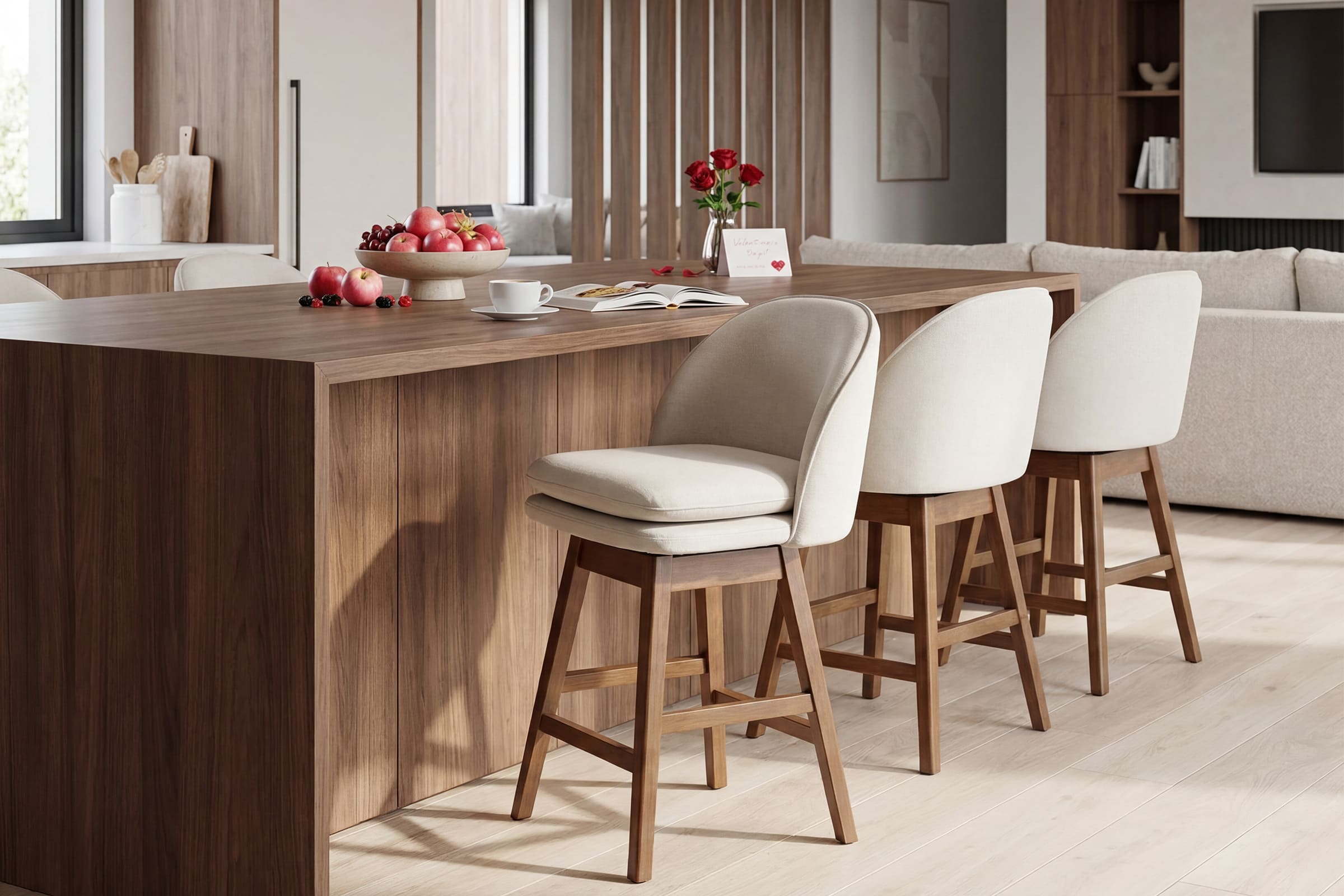
If you want swivel stools vs fixed stools to lean toward swivel without feeling bulky, the 27.5"H Mid-Century Counter Swivel Bar Stools - 6017 are designed for counter seating with a curved backrest, thick cushion, and 360-degree swivel. The listed overall dimensions (19.75"W x 20.5"D x 39.75"H) show a full-chair presence, which can be great for comfort but needs honest aisle measurements. The wood footrest is also a practical Ergonomic Design detail because it gives your feet a stable landing spot instead of searching for a rung.
Fixed Stools For Predictable Footprints
Lock footprint for narrow aisles
Fixed stools win when the aisle behind the seats is the limiting factor. Because the seat does not rotate, you only plan for the footprint you see.
Fixed-seat advantages in tight zones:
- Predictable clearance behind the stool
- Less side-to-side movement between stools
- Often fewer moving parts to maintain
This is the cleanest answer when swivel stools vs fixed stools comes down to a single bottleneck aisle.
Favor lighter frames for easy moves
Fixed stools do not have to be heavy. In small homes, you will move them to sweep, to host, or to create a quick modular furniture moment.
Look for:
- Simple armless frames
- Backless or low-back silhouettes
- Footrests that do not catch shoes
If you prefer a Minimalist Aesthetic, backless fixed stools also tuck visually under the counter.
Chairus product fit example backless fixed wood
For a stable, tuckable footprint, the 26"H Backless Wood Counter Stools - 0519CS use a backless saddle seat and birch wood frame with a footrest, and list dimensions of 19.75"W x 14.75"D x 26"H. That 14.75" depth is the kind of number that matters in a narrow aisle because it reduces how far the stool protrudes when not in use. This style also blends well with Mid-Century Modern and rustic-minimal interiors because the seat reads as a simple wood form instead of a bulky upholstered volume.
Comfort And Ergonomic Design Checks
Prioritize footrest height and seat depth
If you only evaluate one comfort feature, make it foot support. Without a usable footrest, people perch, slide forward, and fidget.
Fast checks that work in real homes:
- Can you rest both feet without pointing toes?
- Does the seat depth let you sit back without cutting circulation?
- Is the footrest placed so shorter users do not dangle?
For stools that will be used for laptop time, seat depth and back angle matter more than you expect.
Manage back support vs profile
Back support is comfort, but it is also bulk. In tight layouts, high backs can visually crowd the room and physically interfere with drawers.
Use this simple rule:
- If sitting is usually 5 to 10 minutes, a low-back or backless stool is fine.
- If sitting is often 20+ minutes, a supportive backrest pays off.
This is where swivel stools vs fixed stools overlaps with Ergonomic Design: longer sits amplify small posture problems.
Chairus product fit example adjustable for mixed users
If your counter height is odd or your household varies in height, an adjustable stool is a practical problem-solver. The Adjustable Swivel Backless Bar Stool - 90117AB lists an adjustable height range of 24.5" to 33" with a 360-degree swivel, plus a metal base and an anti-slip rubber ring intended to protect floors and reduce noise. The product image dimensions also show a 15.25" base width and a 14.25" seat width, which can help you plan the real footprint in a tight aisle.
How To Choose Swivel Stools vs Fixed Stools
Start with the limiting dimension aisle width
When your aisle is tight, decide with one question: will rotation help entry, or will it create collisions?
Use this quick logic:
- If the aisle is the bottleneck, fixed stools often win.
- If entry is awkward but side clearance is decent, swivels can improve flow.
Many kitchen planning resources cite 36 inches as a minimum walkway, but real comfort often improves as you add clearance for pass-through traffic. Measure your actual obstacles (fridge doors, drawers, and corners), then plan for the worst pinch point.
Household use kids guests frequency
Swivel stools vs fixed stools also depends on behavior:
- Kids tend to spin, rock, and climb
- Guests tend to rotate to talk
- Daily users notice squeaks and drift
If stability and predictability matter most, fixed seating reduces surprises. If social comfort matters more, swivels can feel friendlier with less scooting.
Maintenance spills pet hair UV
Material choice is not just aesthetics. It is time.
A practical maintenance stack:
- Faux Leather for wipeable kitchens
- Removable covers if you expect frequent spills
- Simple seams and fewer creases for pet hair
Decision Table Scenarios and Trade-offs
| Scenario | Tight-space Risk | Better Pick | Why It Works |
|---|---|---|---|
| Narrow aisle behind stools | Blocked walkway | Fixed stools | Predictable footprint |
| Easy aisle but hard entry | Scraped floors | Swivel stools | Stand without scooting |
| Kids use daily | Spinning, tipping | Fixed stools | Less sudden motion |
| Entertaining often | Awkward turning | Swivel stools | Guests rotate to talk |
| Pets and spills | Stains, hair | Faux leather | Quick wipe-down |
| Mixed counter heights | Poor clearance | Adjustable | Fit range covers variance |
Conclusion
Swivel stools vs fixed stools is easiest when you decide by space first, then comfort, then style. In a tight room, your limiting dimension (usually the aisle behind the stools) should pick the category for you, and Ergonomic Design checks should pick the exact height and support level.
Re-measure your underside clearance, aisle pinch points, and per-stool width, then shortlist two options: one that is easiest to live with daily, and one that supports how you host.
Official Site: Chairus
FAQ
Are fixed-seat bar stools more stable than swivel ones?
Fixed-seat bar stools are often more stable because they have fewer moving parts and no rotating mechanism to introduce play. However, stability still depends most on base width, weight distribution, and how evenly the stool contacts your floor. A wide base and solid joinery can make a swivel feel steady, while a narrow fixed stool can still wobble. If your floor is slightly uneven, adjustable glides can matter more than swivel vs fixed. For kids or high-energy households, fixed stools reduce sudden motion that can feel unstable.
Do fixed stools take up less room than swivel stools?
Fixed stools can take up less usable room because they do not require extra swing clearance for rotating in and out. In a very tight aisle, that predictable footprint is the main advantage and is easy to plan around. Swivel stools can still work in the same footprint when no one is sitting, but people naturally rotate their shoulders and elbows during use. That extra motion is what creates collisions in compact layouts. If your aisle is the limiting factor, fixed stools usually feel simpler day to day.
What are the pros and cons of swivel bar stools?
Swivel bar stools make it easier to sit down and stand up without dragging the stool legs, which helps protect floors and reduces noise. They also improve social comfort because guests can rotate to talk without repositioning the stool. The trade-offs are added clearance needs for elbows and shoulders, plus the possibility of squeaks over time. Swivels also allow more movement, which can be a downside with kids who like to spin. If your space is tight, a swivel only works when you can budget extra side clearance.
Whats better for a tight space swivel stools or fixed stools?
Fixed stools are usually better when aisle width is the limiting factor because they keep a consistent footprint and reduce accidental collisions. Swivel stools can still be better in tight spaces when the main issue is entry and exit, not the aisle behind the seats. In other words, if you can fit the stool but hate scooting and scraping, a swivel can improve flow. If you already struggle to walk behind seated people, fixed seating is the safer bet. Your best decision comes from measuring the tightest pinch point, not from choosing a style first.
Whats better for entertaining swivel stools or fixed stools?
Swivel stools are usually better for entertaining because they let guests rotate to join conversations without pulling the stool backward. That small convenience reduces constant scooting, which can keep the floor clearer during parties. Fixed stools can still work for entertaining if the aisle is narrow and you need to keep traffic moving. If you host often, prioritize comfort features like a supportive back and a usable footrest so people linger happily. The best choice is the one that matches how people naturally move in your space.
Which is safer for kids swivel stools or fixed stools?
Fixed stools are typically safer for kids because they reduce spinning and sudden sideways movement. A fixed seat also makes it easier to teach consistent habits like sitting centered and keeping feet on the footrest. Swivel stools can be safe if they have a stable, wide base and smooth controlled rotation, but they still encourage motion. If your child tends to climb or rock, choose a stool with a lower center of gravity and predictable behavior. In tight kitchens, safety also includes keeping the walkway clear so kids do not trip on protruding seats.