
Introduction
A stool that feels too short can make your knees ride high, your back round forward, and your feet search for a place to rest. Over time, that mismatch can turn quick meals and casual chats into a constant fidget.
The fix is not just buying a taller seat. You need to measure the right points, account for real knee clearance, and choose a seat style that matches how you actually use the space, including a Hybrid Workspace setup.
This guide walks you through a simple, repeatable process to replace a too-short stool with one that fits better, feels steadier, and blends into modern trends like Quiet Luxury and Smart Furniture.
Key Factors to Consider When Replacing a Too-Short Stool
Factor 1: Calculate ideal seat height range
Once you have the underside height, subtract a comfort clearance.
- Use 10 to 12 inches of clearance as a starting point for most adults.
- Use 12 to 14 inches if you are tall, if the counter edge is sharp, or if you sit for long stretches.
- Use closer to 9 to 10 inches if you prefer a slightly higher perch and do not tuck legs under deeply.
Example math:
- If your countertop underside is 34 inches from the floor, a typical comfortable seat height target is about 22 to 24 inches.
- If your countertop underside is 37 inches, a target is about 25 to 27 inches.
This factor matters because a stool can be labeled 26 inches, yet still feel too short if you need more clearance due to a thick apron or support brackets.
Factor 2: Check seat depth and back style
Seat style changes how you sit, which changes how much clearance you need.
- Deeper seats push you slightly forward or make you scoot back, which can pull your knees upward.
- A full-back or high-back encourages longer sitting, so small height errors feel bigger.
- A backless or low-back design makes it easier to slide in and out, especially in tight kitchens.
If you want a clean Quiet Luxury look, focus on simple lines and a calm material palette.
- Light linen, warm wood tones, and matte metal rings read more refined than bulky frames.
- Upholstery choices matter: Boucle Upholstery can feel cozy, but it can add thickness that changes effective seat height.
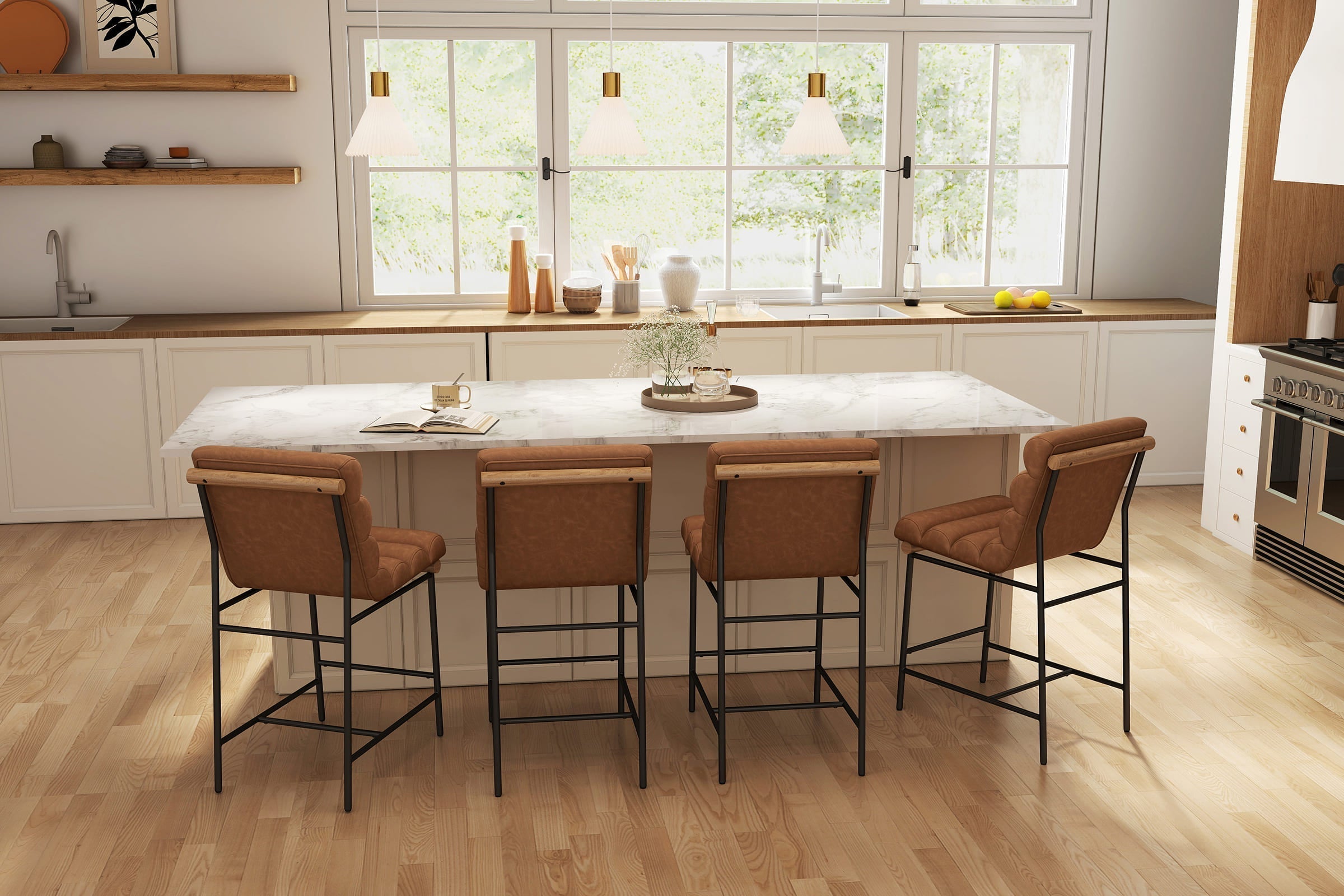
A practical Chairus example for a supportive, structured look is the 25”H Armless Upholstered Counter Stools - 5793CS. It is described as a modern mix of wood, metal, and leather upholstery, with a soft backrest and convenient footrest. The listed overall size is 18.5"W x 24"D x 37.75"H and the weight capacity is 300 lbs.
Product Page: 25”H Armless Upholstered Counter Stools - 5793CS

Factor 3: Evaluate stability and wobble sources
If your current stool wobbles, replacing it with a taller one without checking stability can make the problem worse.
Look for these stability indicators during selection and after assembly.
- Base width: A wider footprint generally resists tip forces better.
- Leg bracing: Stretchers between legs reduce racking over time.
- Hardware access: You should be able to re-tighten bolts after break-in.
At home, do a simple tip-check.
- Place the stool on the actual floor where it will live.
- Rock gently in four directions while holding the seat.
- If it rocks, identify whether the problem is an uneven floor, a loose bolt, or a twisted frame.
For households with kids, treat tip stability seriously.
- The U.S. Consumer Product Safety Commission discusses tip-over risks and stability testing in its mandatory standard process for certain furniture categories, underscoring how real-world forces and surfaces affect stability. According to CPSC, stability testing can include placement on carpeting and simulated interaction weight.
Factor 4: Pick materials for daily wear
Materials determine how your stool looks after months of use, not just day one.
For families and frequent hosting, prioritize surfaces that clean quickly.
- Sealed wood or wood veneer: wipeable, warm, and classic.
- PU upholstery: generally easier to wipe than many woven fabrics.
- Performance fabrics: good for stains, but confirm care instructions.
If Sustainable Materials are part of your decision, ask two practical questions.
- Will the finish and fabric hold up long enough to avoid early replacement?
- Can you maintain it with low-chemical cleaning routines?
Chairus offers stools in multiple materials, including wood frames and upholstered seats.
- The 26.5"H & 30.2"H Farmhouse Rattan Counter Stools Set of 2 - 5739 lists a solid wood frame, a handwoven rattan backrest for breathability, and an upholstered seat. The page also lists a 300 lbs capacity and detailed dimensions.
Product Page: 26.5"H & 30.2"H Farmhouse Rattan Counter Stools Set of 2 - 5739
Factor 5: Validate fit with a 15-minute sit
A stool can feel fine for 30 seconds and wrong after a full meal.
Run a short test that matches your real use.
- Sit for 15 minutes and switch between upright posture and relaxed posture.
- Place both feet on the footrest and see if your hips feel level.
- Turn slightly, as if you were talking to someone across the kitchen.
If you work at the counter sometimes, test a Hybrid Workspace routine.
- Type on a laptop for 3 to 5 minutes.
- Check whether your elbows land comfortably and your shoulders stay relaxed.
- If you plan to pair stools with Height-Adjustable Desks in the same open plan, keep seat comfort consistent so you do not dread switching zones.
For in-between heights or multi-user homes, an adjustable stool can be the simplest way to dial in comfort.
- The Adjustable Swivel Backless Bar Stool - 90117AB lists an adjustable height range of 24.5" to 33" and a 360-degree swivel. It also notes a metal base and an anti-slip rubber ring intended to protect floors and reduce noise.
Product Page: Adjustable Swivel Backless Bar Stool - 90117AB
Adapting Your Approach in Different Scenarios
For a 36-inch island
Most kitchens labeled as standard counter height land around this range.
- Start by measuring underside height, not the top.
- In many homes, a 24 to 26 inch seat height feels right, especially with 10 to 12 inches of clearance.
For a 42-inch bar
Bar-height seating changes your posture and makes footrest position more important.
- Target a 28 to 30 inch seat height if the underside measurement supports it.
- Choose a sturdy base and a footrest that feels natural from multiple angles.
For in-between heights
In-between counters are common in remodels and custom islands.
- Choose adjustable seating when you cannot hit your target clearance with fixed heights.
- Adjustable options can also help if different household members need different heights.
For a Hybrid Workspace setup
If you take calls or do laptop work at the counter, back support often matters more than you expect.
- Prefer a low-back or supportive backrest, not just backless.
- If you also use Modular Furniture pieces nearby, keep seat heights and sight lines consistent so the space feels intentional.
Troubleshooting
| Problem | Cause | Solution |
|---|---|---|
| Stool still feels low | Seat height does not match the underside clearance | Recalculate using floor-to-underside minus 10–12 inches, then re-check compressed seat height. |
| Knees hit the counter | Brackets, trim, or thick edges reduce usable space | Measure at the tightest point, then choose a lower seat or a backless profile. |
| Stool wobbles | Loose hardware or uneven floor | Tighten all bolts, add felt pads, and check level on the placement spot. |
| Feet do not feel supported | Footrest sits too high or too low | Choose a design with a ring footrest or lower stretcher and test with your usual shoes. |
| Stool feels cramped | Seat depth or back angle forces you forward | Try a shallower seat or lower back and confirm hips are fully supported. |
Conclusion
A too-short stool is usually a measuring problem, not a style problem. Measure the countertop underside first, then calculate clearance and confirm seat style, footrest comfort, and stability.
If you want the space to feel current, you can still keep choices practical. Sustainable Materials, Boucle Upholstery, and Recycled Plastics trends matter most when they support daily comfort and durability.
Chairus: Chairs R Us-Dining Chairs, Bar Stools, Benches, Sofas & More
Frequently Asked Questions
How do I measure my counter to pick the right stool height?
Measure from the floor to the underside of the counter, not the top surface, because the underside sets your real knee clearance. Write that number down, then subtract about 10 to 12 inches to estimate a comfortable seat height. If the counter has brackets or trim, measure at the tightest point. Finally, compare that target to the stool seat height and consider cushion compression.
If my stools feel too low, what should I look for in a replacement?
Start by confirming the replacement seat height matches your underside clearance calculation, because small differences can feel big at the knees. Next, check footrest position so your feet rest flat without pointing toes or pressing behind your thighs. Also check whether the seat cushion is thick, because a thick cushion can change how you sit and how high you feel. If you sit often, choose a back style that supports longer sessions.
Should I buy adjustable-height stools if my counter height is in-between?
Adjustable-height stools are a good choice when your target seat height falls between standard sizes like 24 to 26 inches or 28 to 30 inches. Set the stool to your preferred height and make sure the base still feels stable at that setting. You should also verify that the footrest remains comfortable after adjustment, since some designs move the footrest with the seat. If multiple people share the kitchen, adjustable seating can reduce daily discomfort.
What features make counter stools more stable and less wobbly?
A wider base footprint generally improves stability, especially on smooth floors where sliding can happen. Leg bracing or stretchers between legs help reduce side-to-side racking as the stool ages. Tight, accessible hardware is important because most stools need a re-tighten after the first week of use. If your floor is uneven, felt pads or leveling feet can fix small rocks without forcing the frame.
What seat height should I get for a standard kitchen counter?
Many standard counters are around 36 inches, but the underside height can vary with trim and countertop thickness. After measuring the underside, most people land in a 24 to 26 inch seat height range when they keep 10 to 12 inches of clearance. If you are tall or sit for long periods, you may prefer slightly more clearance. Always test with a 10 to 15 minute sit to confirm comfort.
What stool height works best for a 36-inch kitchen island?
For many 36-inch islands, a 24 to 26 inch counter-height stool works well, assuming the underside measurement supports it. The best check is still the underside clearance rule, because some islands have decorative panels that reduce space. If knees touch or feel cramped, step down in seat height or choose a slimmer seat and back profile. If the island is used for laptop work, consider a supportive low-back design for longer sitting.