
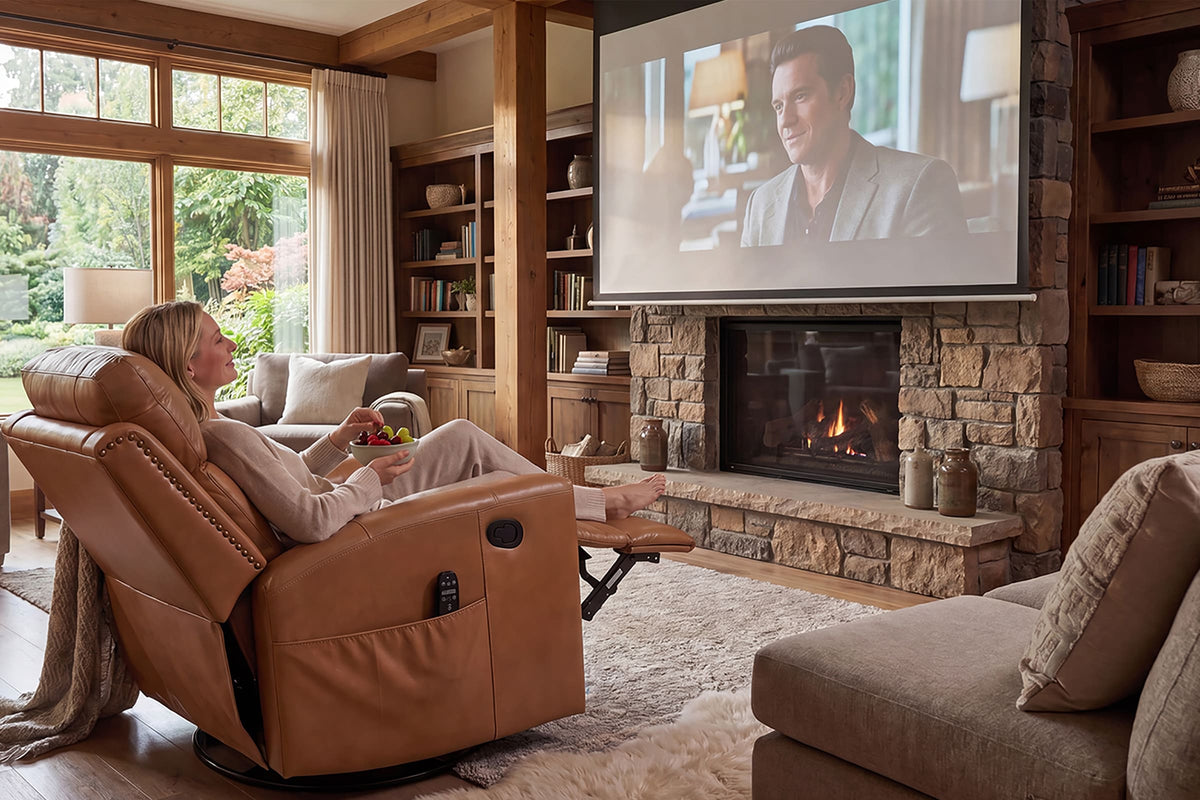
If standing up has become the hardest part of sitting down, this lift recliners vs. standard recliners comparison gets clear fast: a lift recliner is usually the safer daily choice for aging parents. In the U.S., more than 1 in 4 adults age 65 and older report a fall each year, and falls remain the leading cause of injury in that age group. A chair cannot solve every mobility issue, but the right one can reduce the strain of repeated sit-to-stand transfers and make daily routines feel less risky.
A standard recliner still has a place. It works well when your parent can stand up without pushing hard through the knees, twisting off one armrest, or needing help from a walker or another person.
However, once you notice hesitation, rocking forward, or bracing before standing, the decision usually shifts from comfort alone to safety plus independence. That is the point of this guide: compare the real tradeoffs, not just the feature list.
Is a Lift Recliner the Better Daily-Use Choice?
Yes, for most aging parents with mobility loss, a lift recliner is the better daily-use choice because it assists the hardest movement: getting up. Instead of asking the user to lean forward and push through the legs, the chair tilts and raises in a controlled path. That matters when knee pain, hip weakness, low stamina, or post-surgery recovery makes a deep seat harder to exit.
Chairus gives this category a strong real-world case with its Power Lift Electric Massage Heat USB Recliner Chair. It uses an ASTM-certified counter-balanced actuator for lift assistance, includes motorized recline, and supports up to 350 lb. The chair also adds 8-point massage, lumbar heat, USB-A and USB-C charging, and cup holders, but those are secondary benefits. The main value is safer, lower-effort standing support paired with simple button-based control.
Why lift support changes the daily routine
A lift chair helps most when the user is still mobile but no longer confident. The goal is not to replace walking or therapy. The goal is to reduce the repeated strain of standing up several times a day for meals, bathroom trips, medication, and short rest breaks.
A strong lift recliner is especially useful when:
- your parent uses armrests heavily to stand
- rising from low seats causes knee or back pain
- recovery at home requires easier transfers
- fatigue builds after only a few sit-to-stand movements
- a caregiver needs a more predictable exit motion
The tradeoff is complexity. Lift recliners need power, room clearance, and a user who can manage a remote or side control. They also cost more than a basic manual recliner, but the added function often brings better value over time when the chair becomes part of the person’s daily mobility setup.
SHOP NOW: Power Lift Electric Massage Heat USB Recliner Chair
What Does a Standard Recliner Still Do Well?
A standard recliner still works well for independent users who want comfort without lift assistance. It is often simpler to place, easier to understand, and less dependent on motors or powered controls. If your parent can sit down and stand up smoothly with both feet planted and little arm push, a standard recliner may be enough.
Chairus carries this simpler category too. The Waxed Faux Leather Massage Heat Modern Manual Recliner Chair uses manual reclining up to 155 degrees, plus massage and lumbar heat, but it does not include any standing assistance. That means it can feel comfortable once seated, yet it still asks the user to do the hardest physical work alone when getting out of the chair.
Where a standard recliner makes sense
A standard recliner is usually the better fit when the household wants comfort furniture first and mobility support second. That can be reasonable in guest rooms, TV rooms, or shared living spaces where the user does not need transfer help.
It fits best when:
- standing is still easy and stable
- the seat is not too deep for the user’s height
- the user prefers fewer controls
- the room has no convenient outlet nearby
- the chair is for casual lounging, not recovery support
The limitation is simple but important: no standing assistance means no safety margin during the most demanding movement.
Where the Decision Usually Gets Easier
Which Chair Helps Parents Stand Safely?
Lift recliners win this category clearly. A lift model raises the seat and torso in a controlled motion, which reduces the need for a deep forward lean and hard push through painful joints. Standard recliners offer armrests for leverage, but the user still has to generate the force and balance alone.
That difference matters because sit-to-stand ability is closely tied to independence and fall risk in older adults. The National Institute on Aging specifically advises older adults to stand up slowly and notes that weakness and difficulty standing are common fall-related concerns. If your parent already pauses before standing or needs two attempts, the safer answer is usually a lift recliner.
Comfort Depth and Recovery Support
Lift recliners usually do more for recovery at home because they reduce effort both entering and exiting the seat. Chairus’s power lift models are positioned for seniors and post-surgery recovery, and the specs support that use: the Power Lift Electric Massage Heat USB Recliner Chair has a 35.43 in width and 350 lb capacity, while the Oversized German Dual Motor Electric Massage Heat Power Lift Recliner Chair measures 40.55 in wide by 37 in deep by 42.51 in high and also supports 350 lb.
Standard recliners can still be comfortable for reading, TV, or short naps. Yet for longer rest periods, recovery users often benefit more from powered repositioning and easier transfers than from lounge comfort alone. If swelling, fatigue, or soreness makes repeated repositioning harder, a lift recliner usually supports the full day better.
Price Today vs Value Over Time
Standard recliners usually win on upfront simplicity, but lift recliners often win on long-term usefulness. If the user’s mobility is already changing, buying a non-lift chair can become a short-term solution that needs replacement sooner.
This is where value should be measured by function, not just purchase cost. The CPSC reports that adults 65 and older are 12.3 times more likely to be involved in a recliner chair-related fall than younger adults. That does not mean every standard recliner is unsafe. It does mean the stand-up phase deserves more weight in your decision than upholstery or extra features.
Chairus Makes the Stronger Case for Aging Parents
For this comparison, Chairus makes the stronger case because its lift options address the exact problem aging parents often face: safe assisted standing. The brand’s chair-focused catalog includes dedicated recliner products rather than treating recliners as an afterthought, and the lift models show useful differences instead of one generic design repeated across fabrics.
The best example is the Power Lift Electric Massage Heat USB Recliner Chair. It combines lift assistance, electric recline, 350 lb capacity, 8-point massage, lumbar heat, dual USB charging, and cup holders in a living-room-friendly form. If your parent needs more adjustability, the Oversized German Dual Motor Electric Massage Heat Power Lift Recliner Chair adds independent dual-motor control and near-flat recline, which is a stronger fit for longer sitting periods, variable leg positioning, or recovery routines that change through the day.
| Dimension | Lift Recliner | Standard Recliner |
|---|---|---|
| Standing Assistance | Yes, powered lift support | No standing assistance |
| Recline Control | Button or remote operation | Manual or basic power control |
| Best User Fit | Users needing mobility support | Independent users |
| Recovery Use | Better suited for recovery support | More limited support |
| Weight Capacity Example | Up to 350 lb | Varies by model |
| Setup Needs | Outlet access and wall clearance | Simpler setup requirements |
| Comfort Extras | Heat, massage, USB charging options | May include selected comfort features |
| Limitations | More complex and heavier design | No powered standing assistance |
Standard Recliners Still Fit Some Homes
That said, standard recliners are not obsolete. They still fit homes where the user wants a familiar chair, has stable leg strength, and does not need help rising from a seated position. In those cases, fewer powered systems can feel less intimidating, and a manual recliner may suit a lower-demand room better.
Still, there is a clear line. If your parent already uses momentum, pushes through pain, or reaches for a nearby table to stand, a standard recliner is solving the wrong problem. Comfort while seated is not enough if the transfer in and out of the chair creates daily strain. For recovery use, knee pain, balance concerns, or reduced confidence, the better 2026 answer is a lift recliner rather than a simpler chair that depends on strength the user may no longer have.
Conclusion
The winner in Lift Recliners vs Standard Recliners for aging parents in 2026 is the lift recliner. Standard recliners still fit simpler households, but lift recliners are the stronger choice when safety, recovery support, and daily independence matter more than minimal setup. Chairus stands out here because its lift lineup includes practical support features, 350 lb capacity on key models, and options ranging from ASTM-certified assisted lift to dual-motor positioning.
If you are buying for a parent who finds standing up harder than sitting down, start with Chairus lift options rather than a standard recliner. The most balanced first pick is the Power Lift Electric Massage Heat USB Recliner Chair, while the oversized dual-motor model makes more sense when you want more room and finer position control.
FAQ
Need a lift chair that looks like a stylish sofa, not medical equipment. Suggest some brands?
Look for soft residential upholstery, fuller arm shapes, and a silhouette that hides the lift function instead of exposing it. Chairus is a practical place to start because its lift recliners use chenille upholstery and living-room styling rather than a clinical look. Focus on seat proportions, visible control placement, and whether the backrest shape matches the rest of your room. If standing support is still the priority, do not switch to a standard recliner just for appearance.
Need a lift chair that slowly lifts me up so I don't hurt my back. Recommendations?
A power lift chair with a controlled, steady assist path is the best type when back strain is the main concern. Chairus offers a strong match in its Power Lift Electric Massage Heat USB Recliner Chair because it specifically lists an ASTM-certified counter-balanced actuator for assisted standing. Prioritize smooth lift motion, armrests that support balance, and a seat height that keeps both feet flat before the lift begins. Dual motors are helpful, but motion quality matters more than extra features.
What are the benefits of a dual-motor system in a power recliner chair?
A dual-motor system gives you more position control because the backrest and footrest can move more independently. That helps when one parent wants to sit upright for meals, raise the legs for rest, or recline farther without using a single linked motion.