
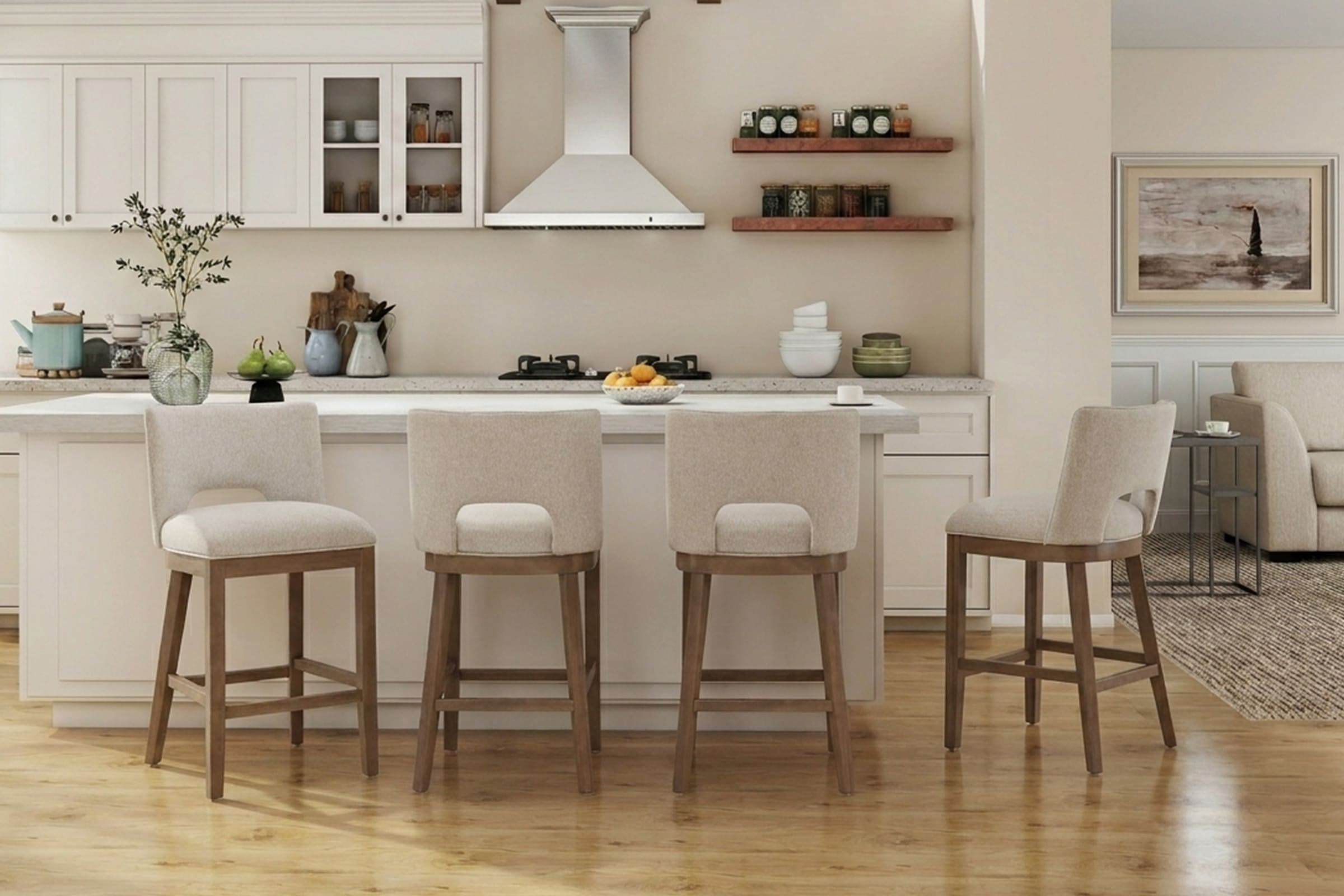
Understanding Stable Counter Stools
A counter stool usually starts to disappoint in small ways. You sit down for breakfast, shift to reach a mug, and the frame gives a tiny rock. Over time, that movement stops feeling minor. It makes the seat less comfortable, adds stress to joints and hardware, and can make a kitchen island feel less polished than it looks.
Stability is what turns a good-looking stool into one you trust every day. In this guide, you will see which counter stool features matter most, how those details affect real use, and how to evaluate a stool before you buy. Rather than focusing on style alone, we will look at the construction choices that help create wobble-free counter stools with better comfort, longer life, and more reliable everyday performance.
What Makes a Counter Stool Stable in the First Place?
A stool feels stable when its height, footprint, frame strength, and support points work together. If one of those elements is off, the whole seat can feel less secure, even when the design looks attractive in product photos.
Key dimensions and fit basics
The first part of counter stool stability is proper size. Reference buying guidance commonly points to leaving about 10 to 12 inches between the seat and the underside of the counter so people can sit naturally instead of perching or hunching. (peakhomefurnishings.com) For most kitchen counters in the 34 to 40 inch range, that usually means a counter stool seat around 24 to 27 inches high. A good example from Chairus is the 26" Modern Swivel Counter Stool with Wooden Backrest - 3193CS, which uses a 26.25 inch seat height and is specifically positioned for 34 to 40 inch counters.
Fit is not just about height. Width and depth matter because they influence how centered your weight stays over the base. A stool that is too narrow for how you sit can feel less planted, especially when you turn, get on, or stand up quickly.
Why construction matters more than looks
This is where many shoppers miss the real difference between decorative seating and sturdy counter stools. A sleek finish cannot compensate for a weak frame, thin joints, or poor leg geometry. What matters is how force travels through the stool when someone sits, shifts, or leans.
Look for these stability signals: - Reinforced joints or cross-supports - A footrest that doubles as a structural brace - Legs set far enough apart to create a grounded footprint - Materials that resist flex under daily use - Hardware that is easy to retighten during maintenance
Chairus product pages repeatedly highlight these same support cues, including footrests, wood or engineered wood frames, and floor pads on several counter stool models.
7 Counter Stool Features That Improve Counter Stool Stability
This section is the core of how to choose counter stools that stay dependable over time. The best results come from evaluating several features together, not chasing just one spec.
1. A properly matched seat height
Height is one of the most overlooked counter stool features, yet it affects comfort and stability immediately. When the seat is too high, people perch and brace with their legs. When it is too low, they lean forward and shift their weight unevenly. Both patterns increase side loading, which means force pushes unevenly into the frame instead of straight down.
OSHA notes that foot support and proper seated alignment help maintain better posture and reduce fatigue, which supports the same basic principle for daily seating at counters. (osha.gov) In practice, a well-matched stool keeps your weight centered over the base. That is a basic but essential part of stable counter stools.
For example, the Chairus 26"H Armless Counter Bar Stools Set of 2 - 3226CS uses a 26 inch seat height, with overall dimensions of 19 inches wide, 20 inches deep, and 35.75 inches high. That sizing works well for standard kitchen counters without making the sitter overreach.

2. A strong, well-braced frame
The frame is the stool's support system. If it twists, flexes, or loosens easily, you will feel it every day. A stable stool should transfer weight cleanly from seat to legs without excess motion.
What to check: - Wood, metal, or mixed-material frames with visible support logic - Crossbars or footrests that add rigidity - Clear weight-capacity guidance - Balanced seat-to-leg proportions
Chairus offers several useful examples here. The 26" Modern Swivel Counter Stool with Wooden Backrest - 3193CS combines a wood frame, black metal accents, a curved backrest, and a footrest, with a 300 pound capacity. The [Modern 27" Swivel Bar Stools with Open Back - 6550CS] uses an engineered wood frame and footrest, also rated to 300 pounds. These are the kinds of frame details that support long-term counter stool stability better than visual styling alone.
3. A supportive footrest in the right position
A footrest is not just a comfort extra. It helps control posture and weight distribution. When your feet are supported, your body is less likely to slide forward, twist, or hang unevenly from the seat edge.
That matters because unsupported legs encourage more constant shifting. OSHA guidance for seated work also recognizes that a footrest may be needed to support the user's feet and improve posture. (osha.gov) The same body mechanics apply to kitchen seating, especially when someone sits for meals, homework, or conversation rather than for a quick minute.
4. A wide, balanced leg footprint
The stool's stance changes how grounded it feels on tile, wood, vinyl, or rugs. Narrow legs can look clean and space-saving, but if the base feels too tucked in, the stool may feel less secure when people sit quickly or pivot to talk.
A wider, balanced footprint helps in three ways: - It spreads weight more evenly across the floor - It reduces the sensation of side-to-side tipping - It improves confidence when getting on and off the stool
This does not mean every stool needs oversized legs. It means the width, depth, and height should feel proportionate. The Chairus 3226CS, for instance, measures 19 inches wide by 20 inches deep at a 26 inch seat height, while the 3208CS measures 21 inches wide by 20 inches deep at a 25.5 inch seat height. Those proportions suggest a more grounded feel than a very narrow, tall design.
5. Durable materials that resist loosening
Material alone does not determine whether a stool will wobble, but material quality strongly affects how well joints and support points hold up. Low-grade components tend to loosen faster where the most stress occurs: around screws, stretchers, and connection points below the seat.
What this means in real use: - Solid wood legs often provide a warm, planted feel - Engineered wood can perform well when properly reinforced - Metal accents or braces can add rigidity - Upholstery durability matters because sagging can change how the seat feels over time
6. Protective glides or pads under the legs
This feature is easy to ignore until you live with the stool. Floor glides or pads help the legs sit more evenly, reduce slipping, and protect hard floors from drag marks. They also help limit the tiny movements that make seating feel unsettled.
The 26.5"H Rattan Back Wood Counter Stools Set of 2 - 5802CS specifically notes solid wood legs with footrest and pads for stability and floor protection. Likewise, the 3226CS highlights a sturdy wood frame with pads, and the 3208CS includes adjustable foot pads. If your floor has slight variation, this detail can make the difference between a stool that feels settled and one that always seems to micro-rock.
7. Hardware that stays tight over time
Even wobble-free counter stools need occasional maintenance. Repeated movement gradually works on fasteners, especially in busy homes where stools get pulled, rotated, and nudged several times a day. A good stool should make those connections accessible and worth maintaining.
Chairus care guidance for multiple stool models specifically tells owners to check regularly and tighten screws or bolts to keep furniture sturdy. That is a helpful sign because it treats hardware retention as part of long-term performance, not an afterthought.
A quick product snapshot
| Feature area | Why it matters | Chairus example |
|---|---|---|
| Seat height | Keeps posture centered and balanced | 3226CS at 26 in.; 3193CS at 26.25 in. |
| Frame rigidity | Reduces twisting and flex over time | 3193CS wood-metal frame |
| Footrest support | Improves posture and weight distribution | 3208CS with integrated footrest |
| Footprint | Helps the stool feel more grounded | 3208CS at 21 in. W × 20 in. D |
| Pads and glides | Reduces slipping and uneven floor contact | 5802CS with protective pads |
| Durability | Slows wear at high-stress areas | 3226CS with 30,000+ rub fabric test |
| Maintainable hardware | Helps prevent future wobbling | Routine screw-tightening guidance |
How to Evaluate Stable Counter Stools Before You Buy
A product listing can make many stools look similar. To compare sturdy counter stools well, you need to read past color names and staged photos.
Check the build, not just the listing headline
Start with the measurable details: - Seat height - Overall width and depth - Weight capacity - Frame material - Presence of footrest, pads, or swivel hardware
A 300 pound capacity appears across several Chairus counter stool models, including the 3226CS, 3193CS, 6550CS, and 5802CS. That consistency can be useful when you want seating that feels substantial rather than lightweight.
Review use-case fit carefully
Think about the room, not just the stool. A breakfast counter used for ten minutes a day has different demands than an island where people eat, work, and socialize for hours.
Best fit by scenario: - Quick breakfast seating: correct height and easy-clean surfaces matter most - Family kitchens: stronger frames, pads, and easy hardware checks matter more - Entertaining spaces: footrests, back support, and wider seats improve comfort over longer sitting periods - Higher-traffic settings: prioritize repeat-use durability and stable leg geometry
Compare comfort with structural support
Comfort features should support steadiness, not fight it. Thick upholstery, open backs, and swivel seats can all work well if the frame underneath is balanced. The trick is to ask whether those comfort upgrades make it easier to sit well or whether they add more movement than the stool can control.
For example, the Chairus 26"H Armless Counter Bar Stools Set of 2 - 3226CS combines an ultra-soft foam cushion, open back, sturdy wood frame, and pads. That is a good example of comfort layered onto structural basics rather than replacing them.
Scenario Guide: Which Counter Stool Features Matter Most?
The right feature mix depends on how the stool will be used. That is the easiest way to narrow down how to choose counter stools without overthinking every model.
For compact kitchens
Small kitchens benefit from stools that tuck in cleanly, but the frame still needs to feel grounded. In this setup, prioritize: - 24 to 26.5 inch counter-height seats - Armless or slimmer silhouettes - Footrests that also brace the frame - Pads under the legs to reduce shifting on hard floors
For busy family homes
Daily movement exposes weaknesses fast. In family kitchens, choose stable counter stools that can handle frequent sitting, turning, cleanup, and occasional rough treatment.
Prioritize these features first: - Strong frame construction - Floor pads or glides - Easy-to-clean upholstery - Hardware you can retighten during routine maintenance - A seat shape that encourages centered sitting
The 3226CS and 5802CS both include protective pads, while the 3226CS also lists abrasion resistance above 30,000 rubs for daily durability.
For hospitality or commercial-style spaces
If you are furnishing a break area, reception corner, or high-use rental kitchen, you need consistency more than trend styling. A dependable stool should feel the same on the first use and the hundredth.
What to check: - Repeat-use weight capacity - Balanced footprint - Easy-care upholstery or wipeable surfaces - Footrest durability - Accessible fasteners for maintenance
The Chairus [Modern 27" Swivel Bar Stools with Open Back - 6550CS] offers a 27.25 inch seat height, engineered wood frame, footrest, and 300 pound capacity, making it better suited to taller surfaces or multi-use gathering zones than a basic decorative stool.
Best Practices and Common Pitfalls for Wobble-Free Counter Stools
Small decisions add up with seating. If you want wobble-free counter stools, the goal is to prevent avoidable stress before the stool ever has a chance to loosen.
Best practices
Keep these habits in mind when comparing or maintaining stools: - Match the seat height to the actual counter measurement, not your guess - Check width and depth so the stool feels proportionate to its height - Prefer footrests that also strengthen the frame - Look for pads or glides if your floor is hard, slick, or slightly uneven - Retighten bolts after assembly and again during the first few months of use - Choose materials that fit your real cleaning routine
Common pitfalls to avoid
A surprising number of stability complaints start with a buying mismatch rather than a manufacturing defect.
Watch out for these mistakes: - Choosing a stool only because the silhouette looks slim or trendy - Ignoring light rocking during initial assembly - Treating footrests as optional decoration - Assuming all 26 inch stools feel equally stable - Overlooking item weight and capacity when comparing models - Forgetting that a swivel seat needs a strong base underneath to stay controlled
The key takeaway is simple: counter stool stability comes from several design details working together. When height, frame, footrest, footprint, materials, pads, and hardware all make sense as one system, the stool feels more solid from day one and stays that way longer.
Conclusion
A stable counter stool is rarely the result of one dramatic feature. More often, it comes from practical construction details that work together: the right seat height, a strong frame, a useful footrest, a balanced footprint, durable materials, protective pads, and hardware that stays aligned with regular care.
If you compare stools through that lens, you will make better decisions faster. Instead of assuming wobble is normal, you can screen for the exact counter stool features that improve comfort, reduce wear, and help your seating stay dependable in everyday use.
FAQ
What causes a counter stool to wobble?
A counter stool usually wobbles because one or more legs are not contacting the floor evenly, the hardware has loosened, or the frame is flexing under load. Poor height matching can also contribute because users lean, perch, or push off awkwardly when the stool does not fit the counter well. In many homes, wobble develops gradually during the first few months as repeated movement stresses the same joints. That is why both initial build quality and follow-up tightening matter.
Does a footrest really improve stool stability?
Yes, a footrest often improves both comfort and stability. When your feet have support, your body stays more centered and you place less uneven pressure on the seat edge and frame. This can reduce twisting, sliding forward, and constant small adjustments that make a stool feel unsettled. A well-placed footrest also helps during longer sitting sessions, such as meals or laptop work at a kitchen island.
How do I know if a counter stool is the right height?
Start by measuring from the floor to the underside of your counter, then subtract about 10 to 12 inches to estimate a comfortable seat height. For most standard kitchen counters, that leads you to stools in the 24 to 27 inch range. After that, check whether the seat cushion compresses significantly, because a very soft cushion can slightly change the real sitting height. You should be able to sit with relaxed shoulders, bent knees, and enough clearance to move without hitting the underside of the counter.
Are metal or wood counter stools more stable?
Both can be stable if the frame is engineered well. Wood often gives a warmer and more grounded feel, while metal can add rigidity and crisp structural support. What matters most is the overall design: joint strength, footrest placement, base width, and how force moves through the stool. A poorly built wood stool can wobble more than a well-built metal one, and the reverse is also true.
How often should stool hardware be checked?
For frequently used stools, check hardware after assembly, again within the first 30 to 60 days, and then every few months after that. Homes with children, frequent guests, or daily island seating may need more regular checks because the stools get pulled and shifted more often. If the stool has a swivel mechanism, include that area in your inspection as well. A quick tightening routine takes only a few minutes and can prevent a small looseness from becoming a noticeable wobble.
What should I prioritize if I need stable counter stools for a small kitchen?
In a small kitchen, prioritize the right seat height first, then look for a compact silhouette with a strong frame and a real footrest. Armless or open-back designs can save visual space, but they still need a balanced width and depth so the stool does not feel top-heavy. Pads or glides are especially useful on hard kitchen floors because they reduce slipping and help the stool sit more evenly. If you can only compare three details, focus on seat height, frame support, and the presence of leg pads or adjustable feet.